
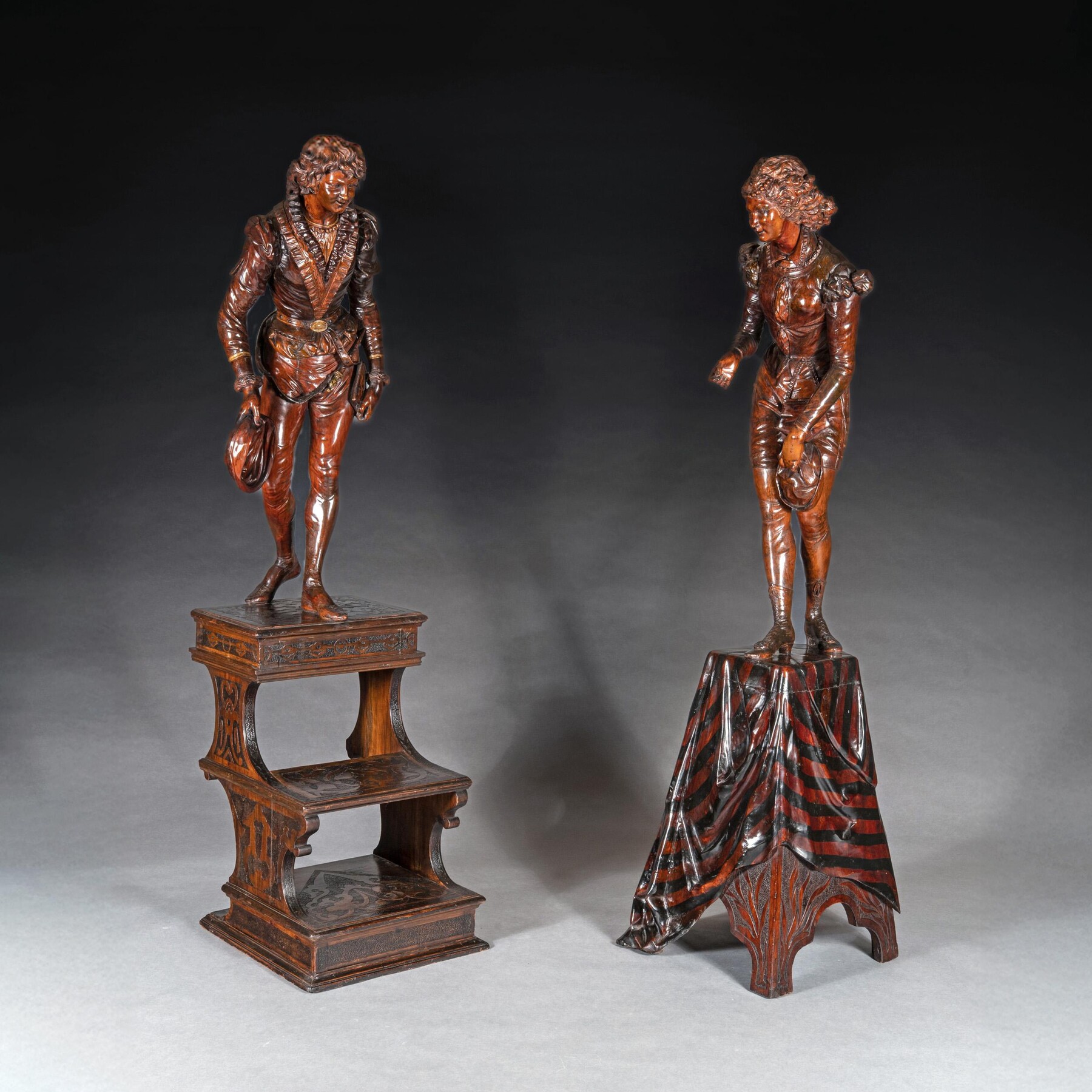
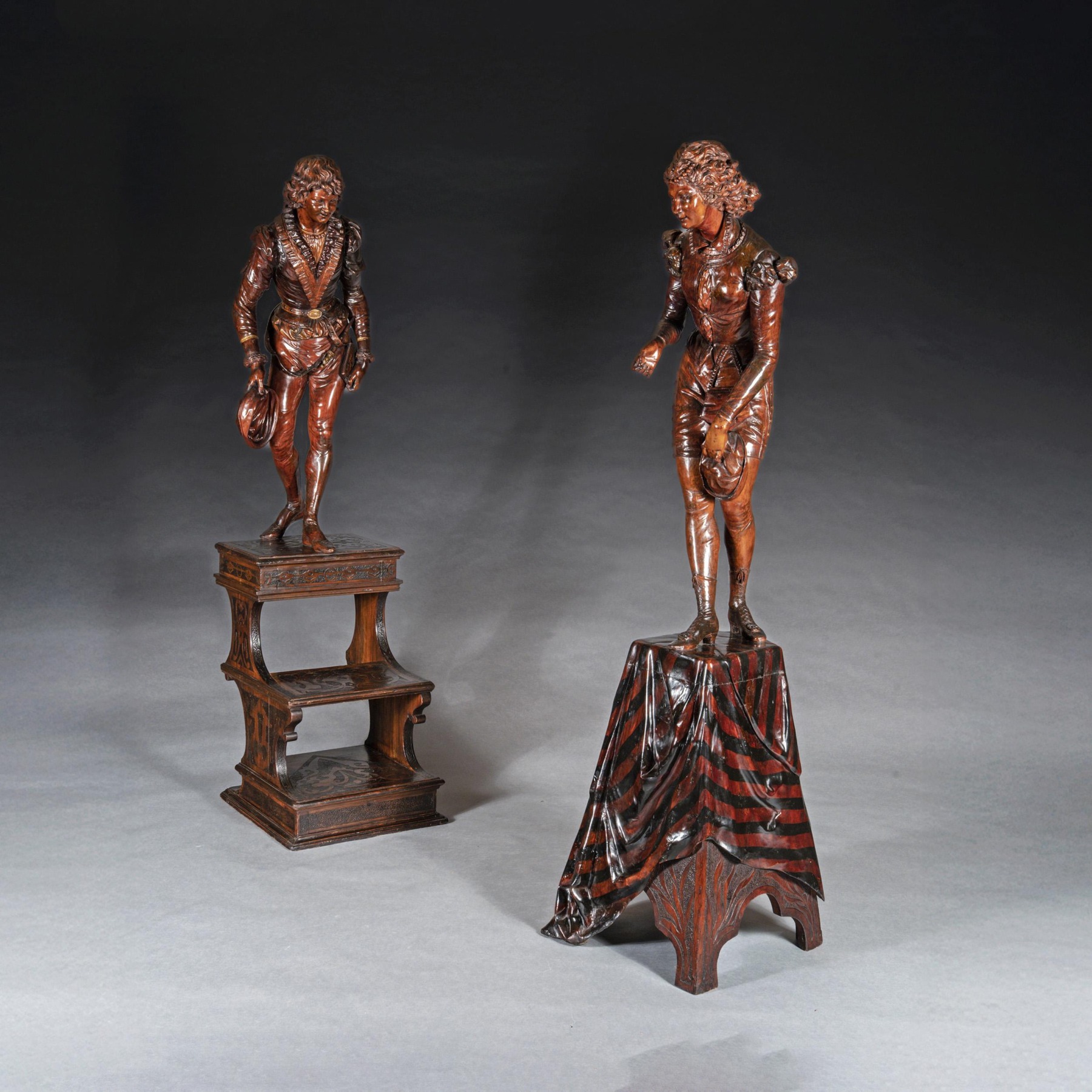
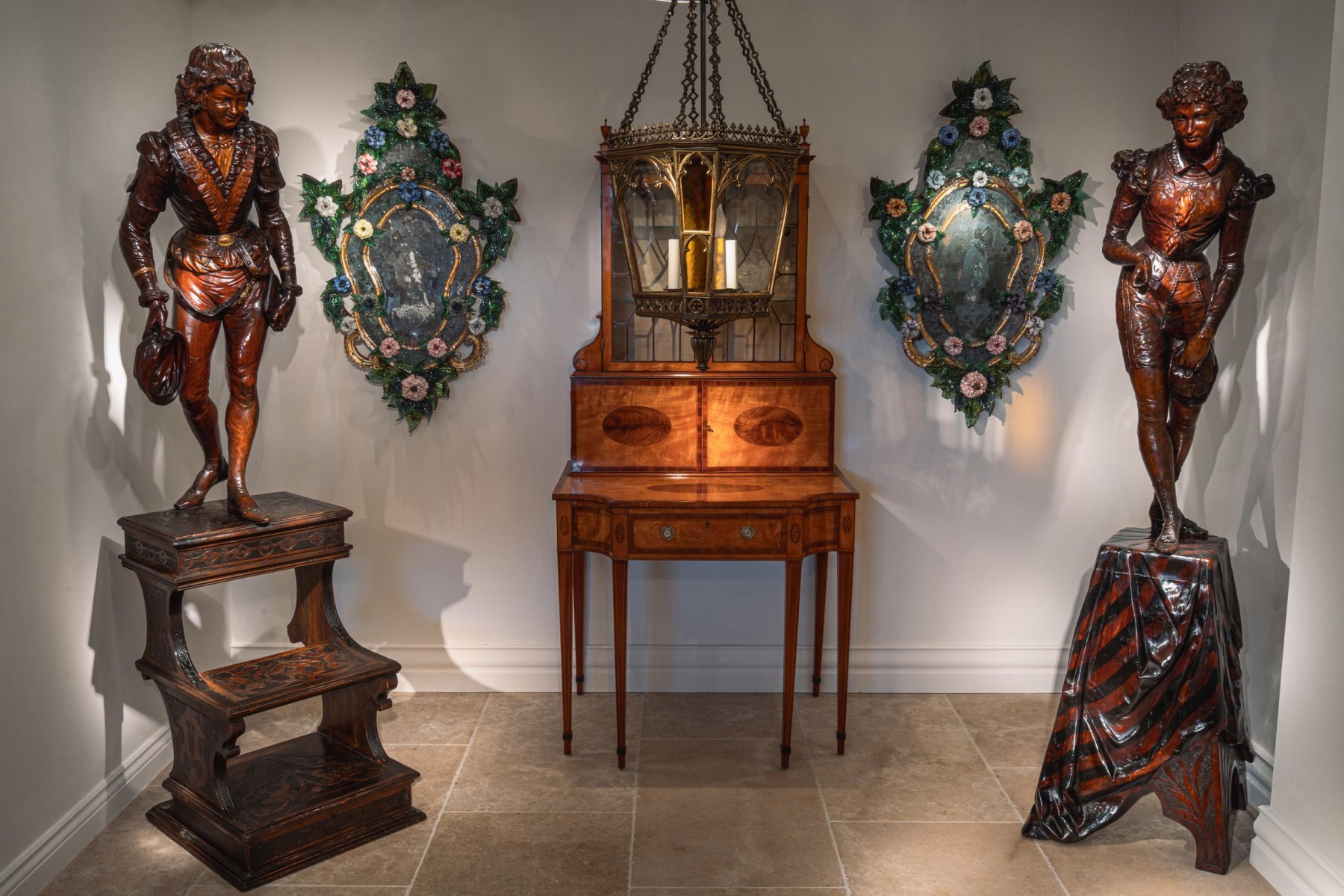
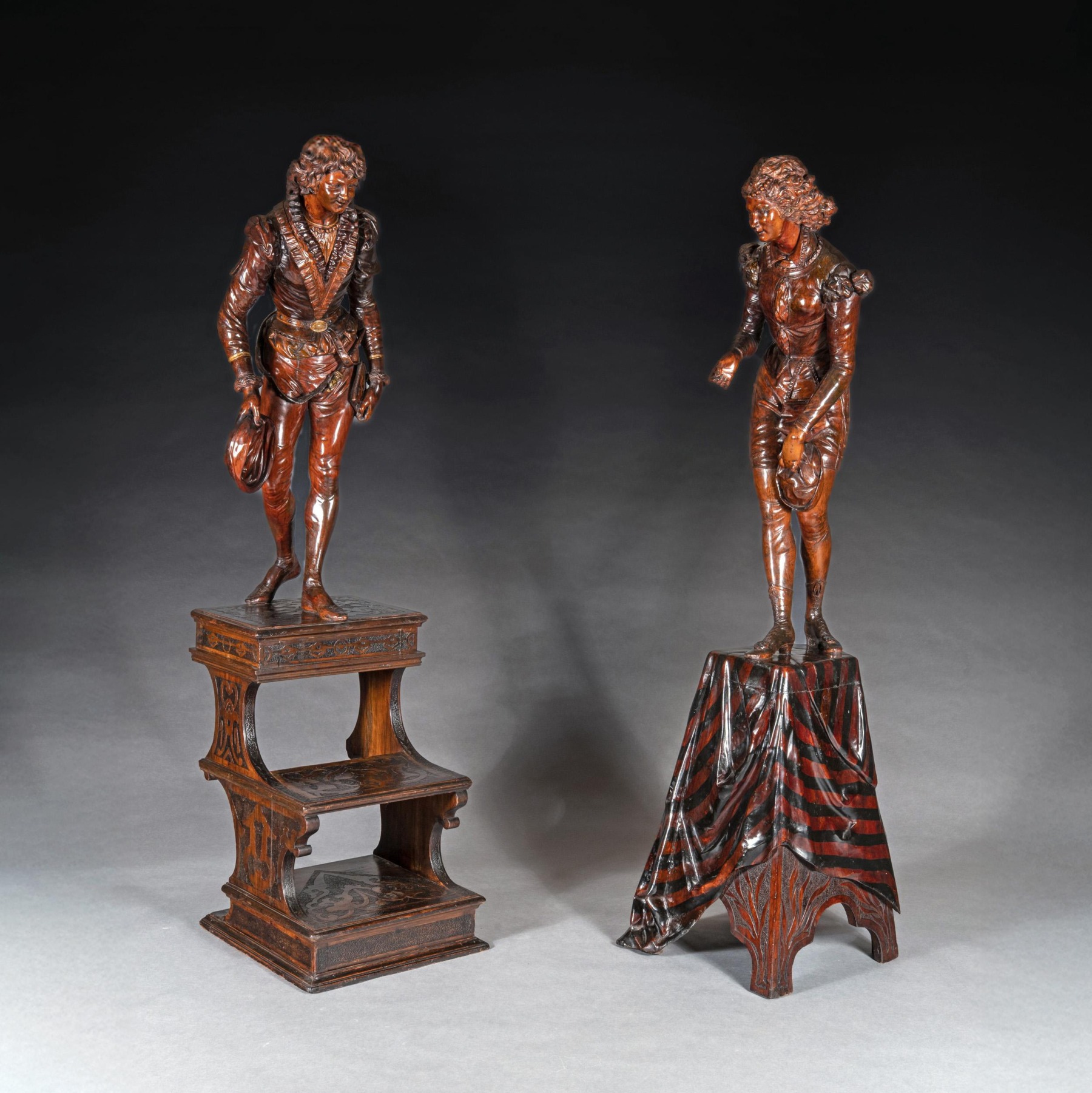
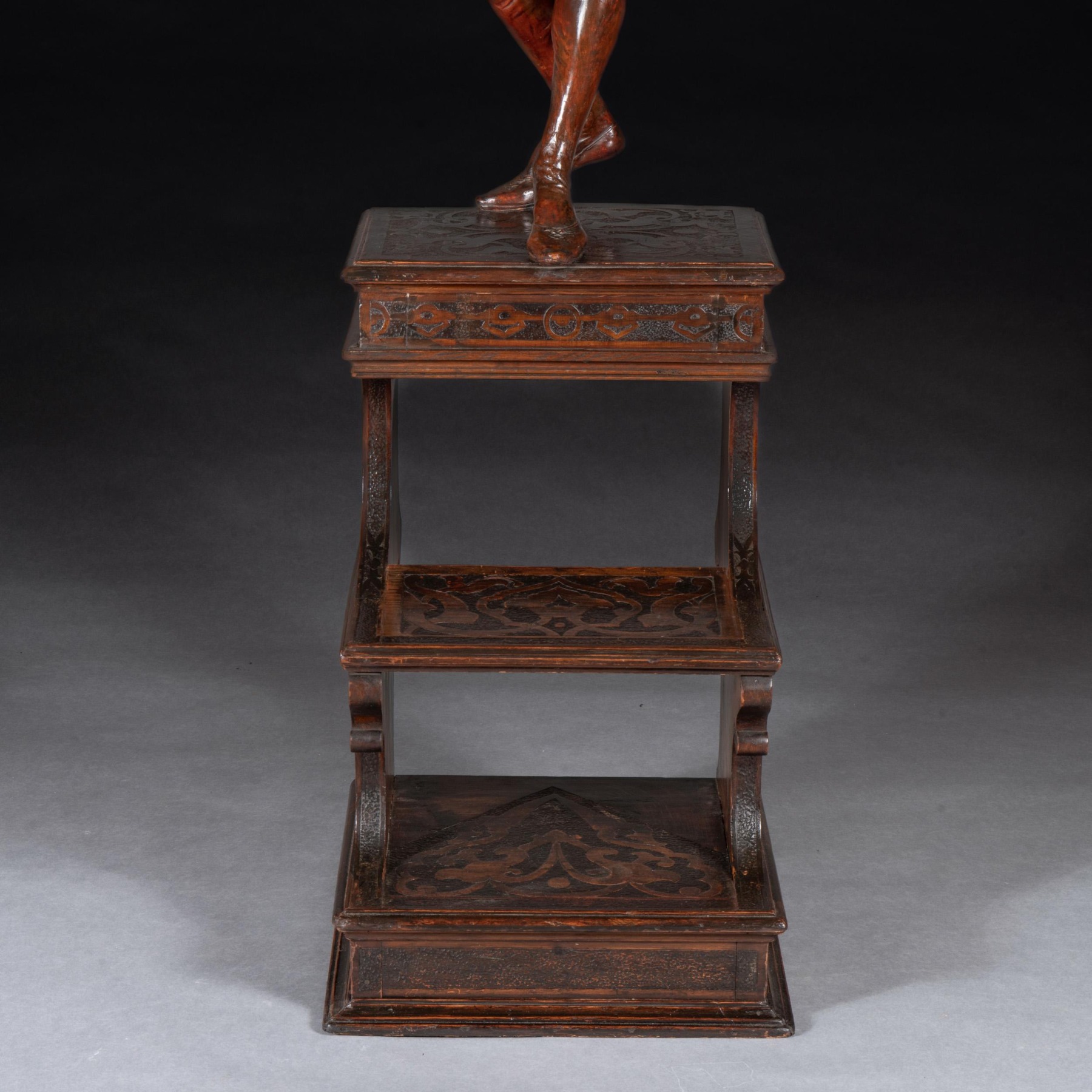
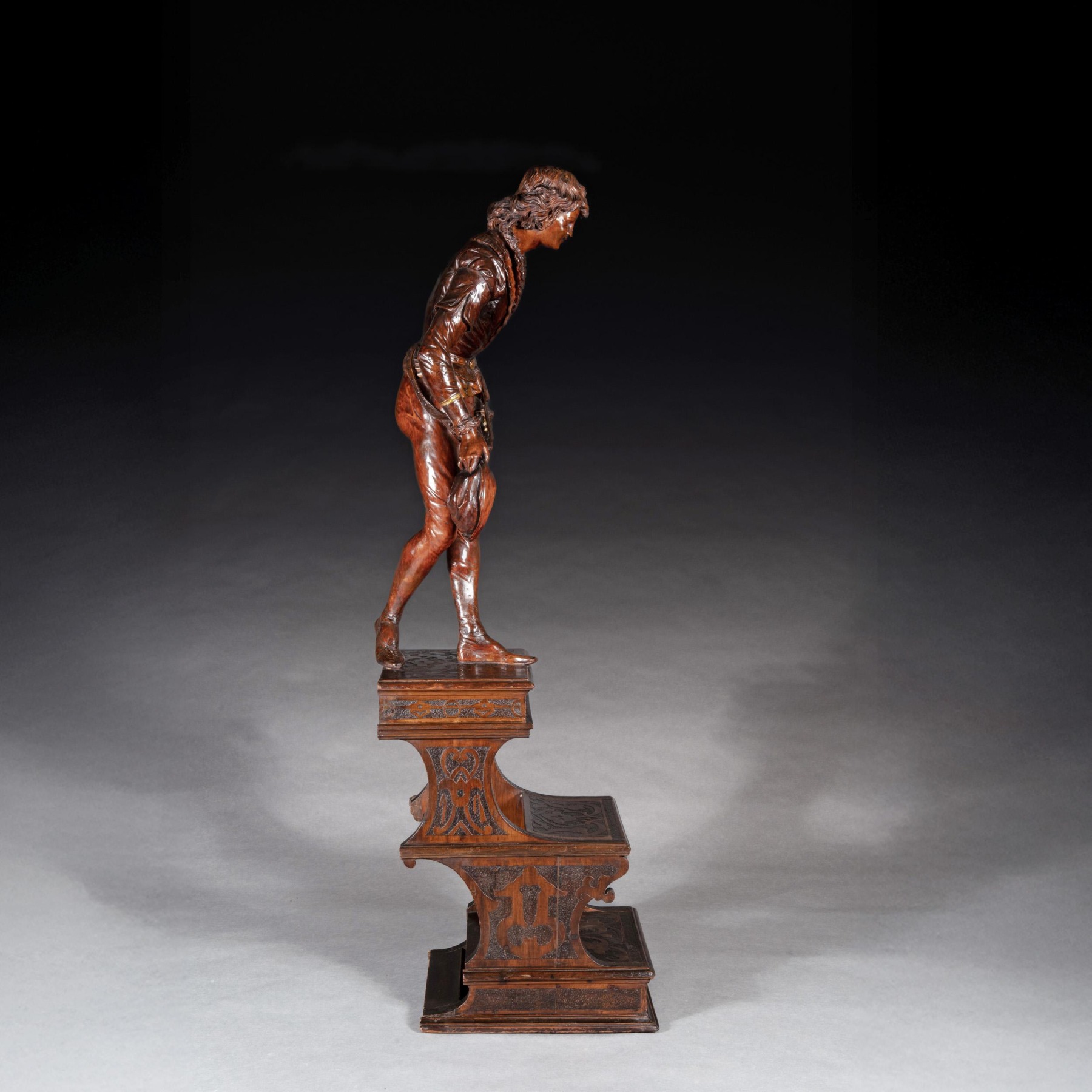
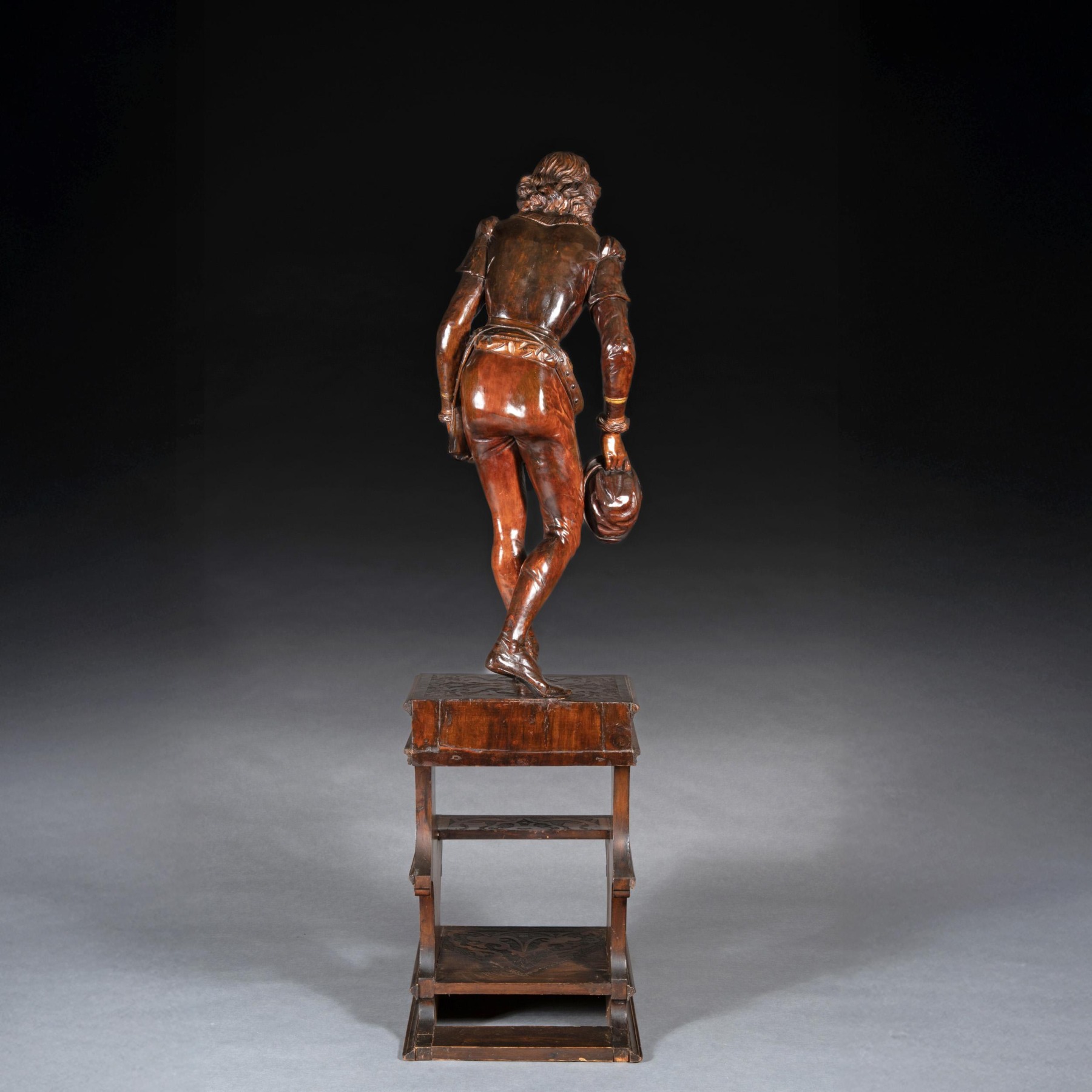
Valentino Besarel Pair of Carved Italian Venetian Figures #3093
A Fine and Imposing Pair of Large-Scale Carved Walnut Venetian Figures in Elaborate Costume by Valentino Besarel (1829-1902)
Provenance
By repute the collection of Harvey c. Wheeler, owner of the Initial Towel Supply Company in Boston, who died in 1947
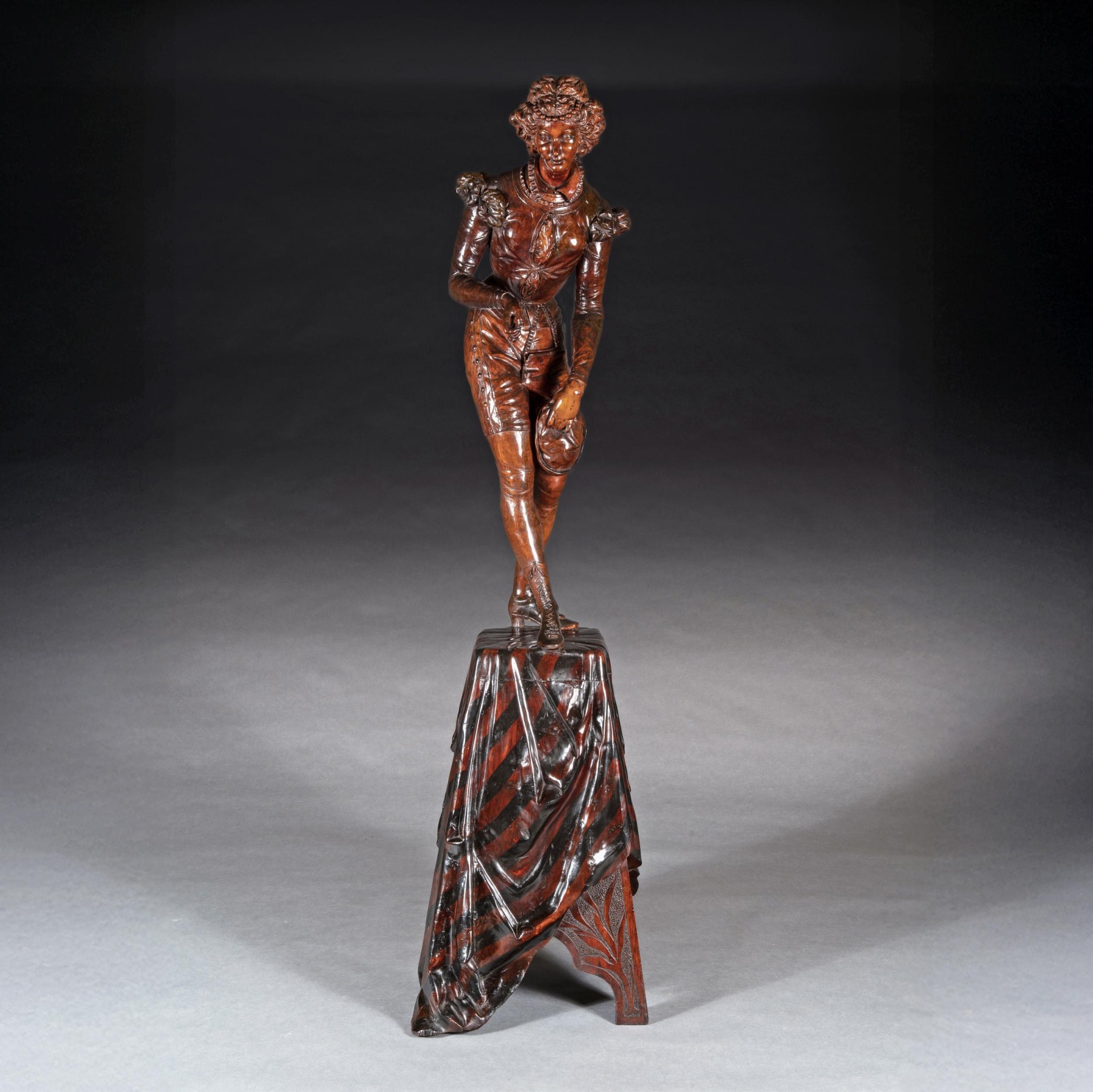
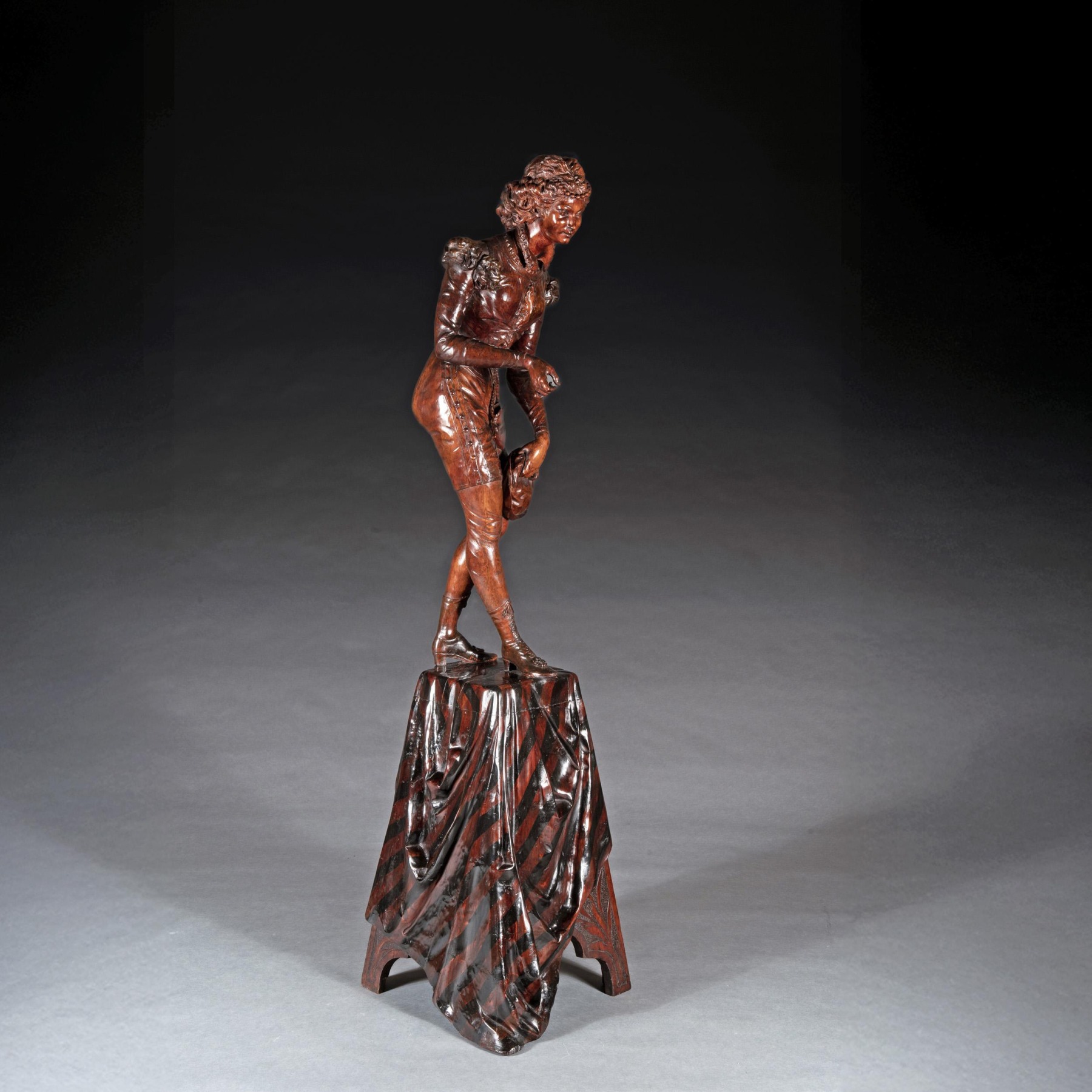
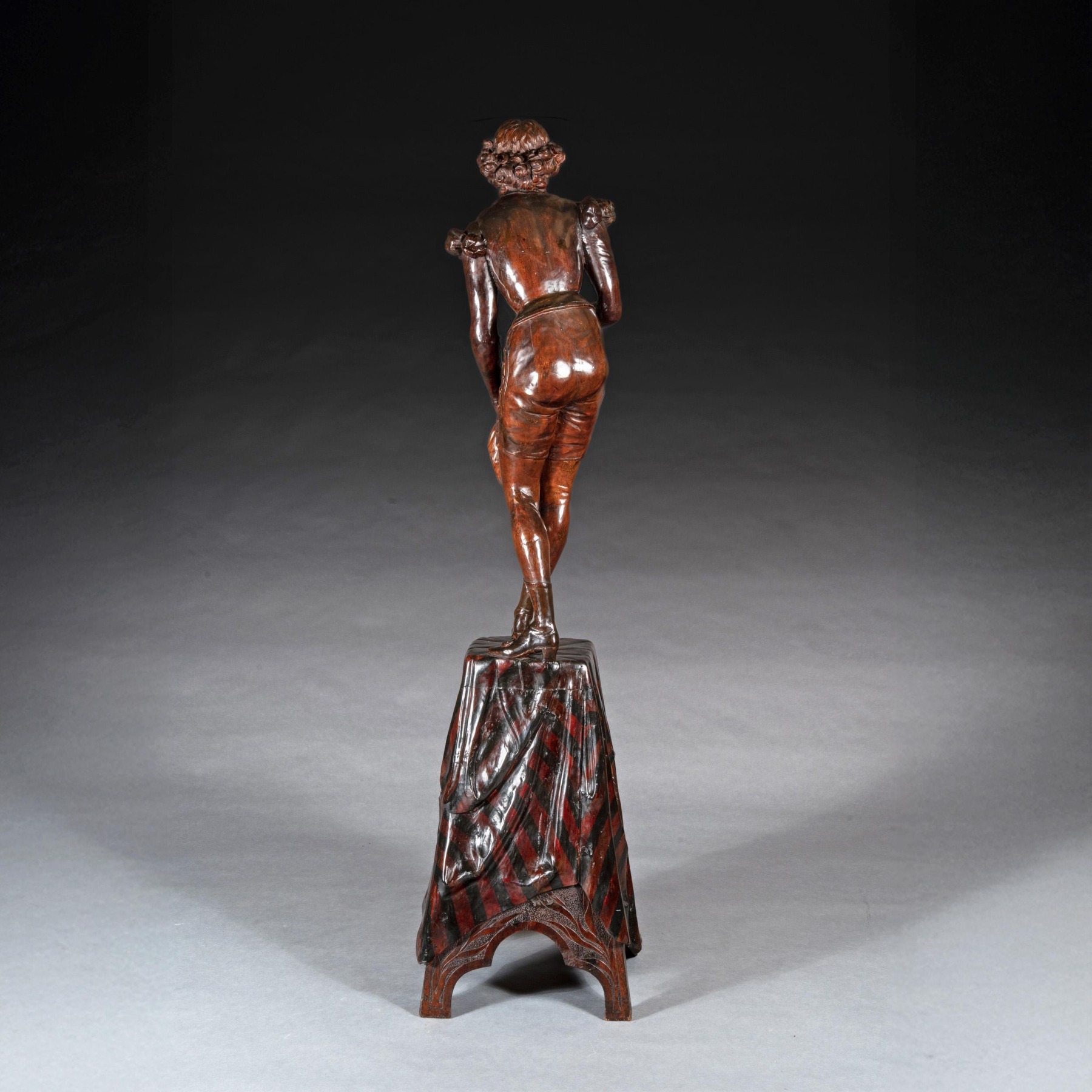
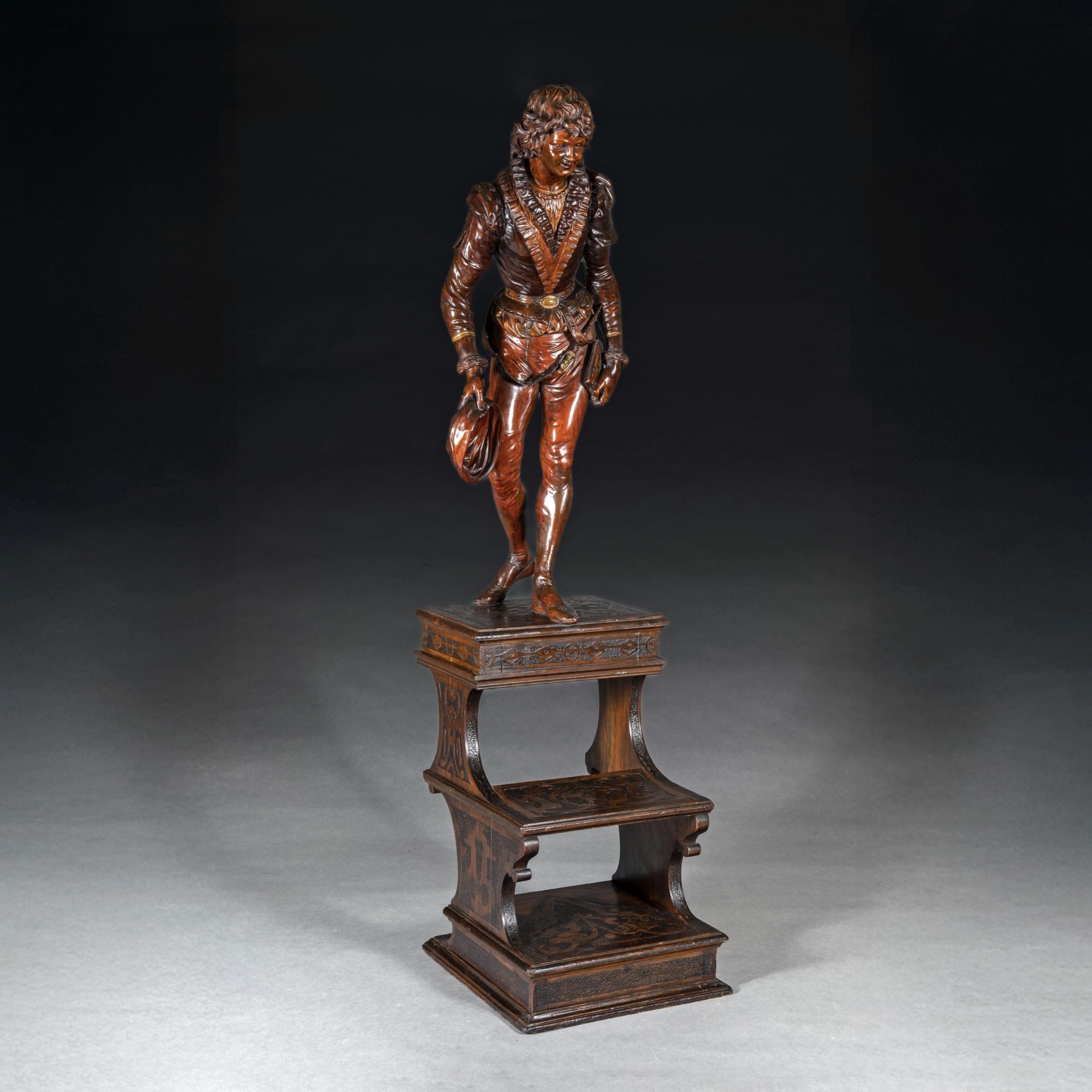
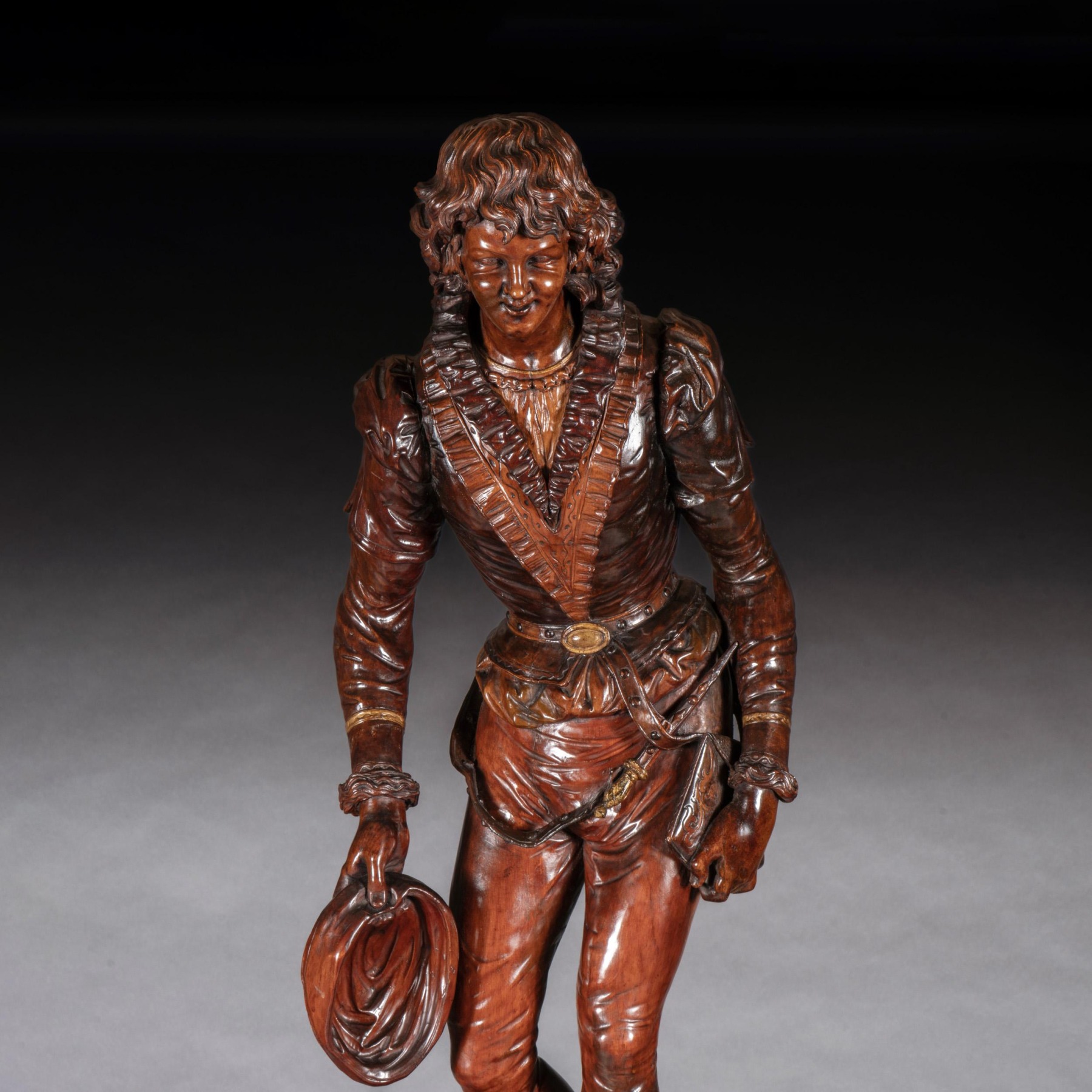
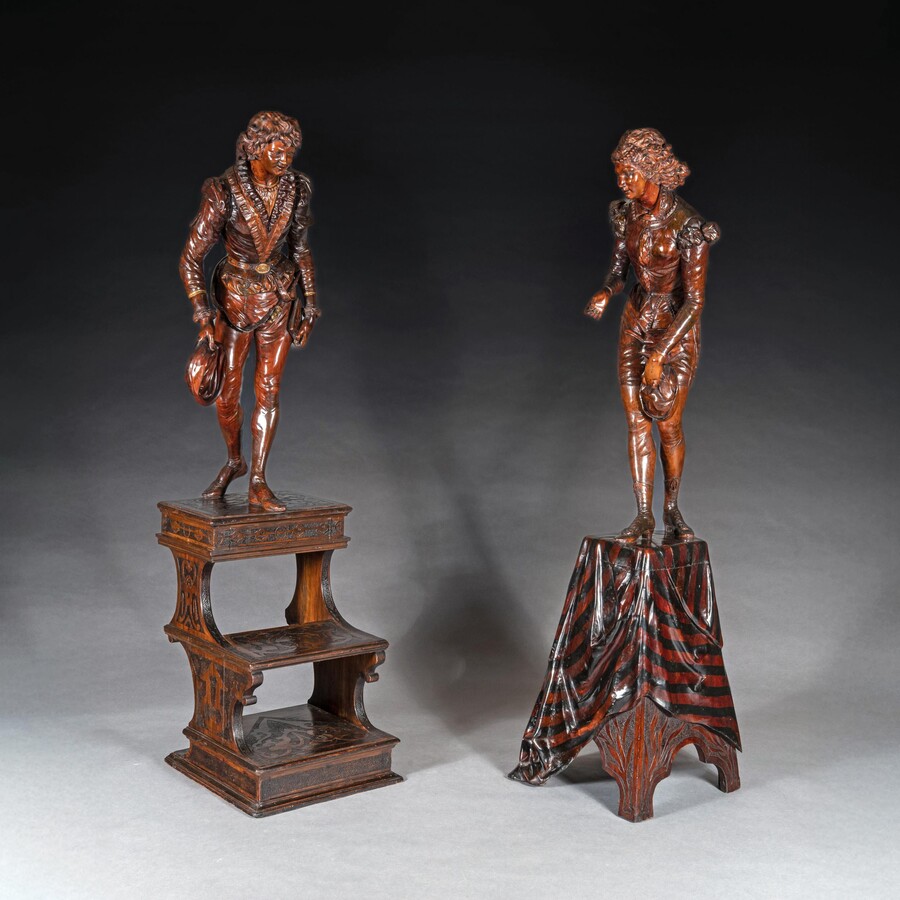
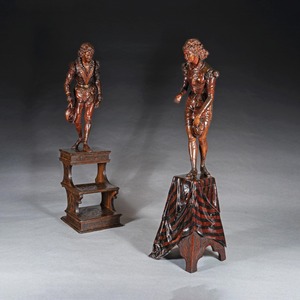
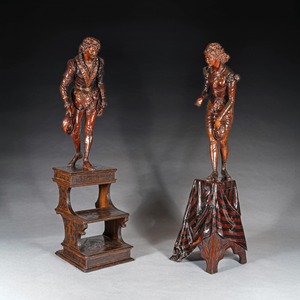
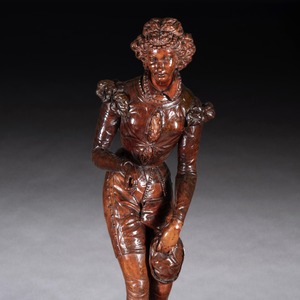
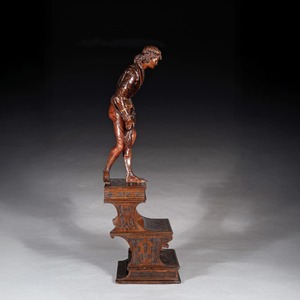
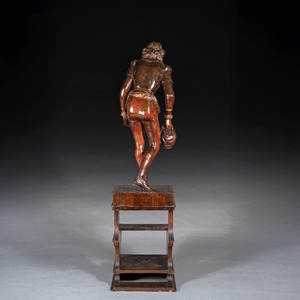
Two carved figures, one female and one male, carrying matching caps in their hands and clearly produced as a pendant pair.
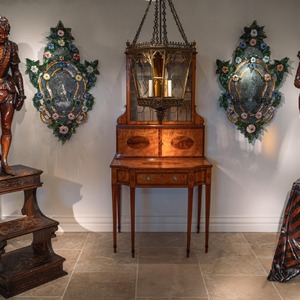
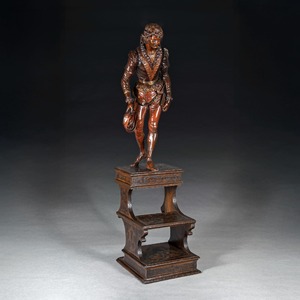
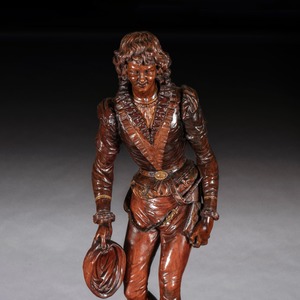
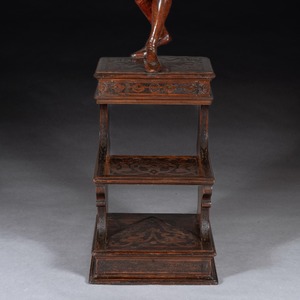
The male figure stands upon a set of three stairs with beautifully carved strapwork designs on the sides and the treads against a stippled ground. He carries a book in one hand and wears a short sword or dagger around his waist. The folds of his costume are beautifully carved with remarkable realism and certain parcel gilt highlights are used to suggest gold bands on his arms and a belt buckle on his waist. His ruffled collar is superbly carved but perhaps the most impressive of all the details might be the way the tongue of the belt drapes down over and around the sword, the pose being incredibly true to life and difficult to achieve in a carving.
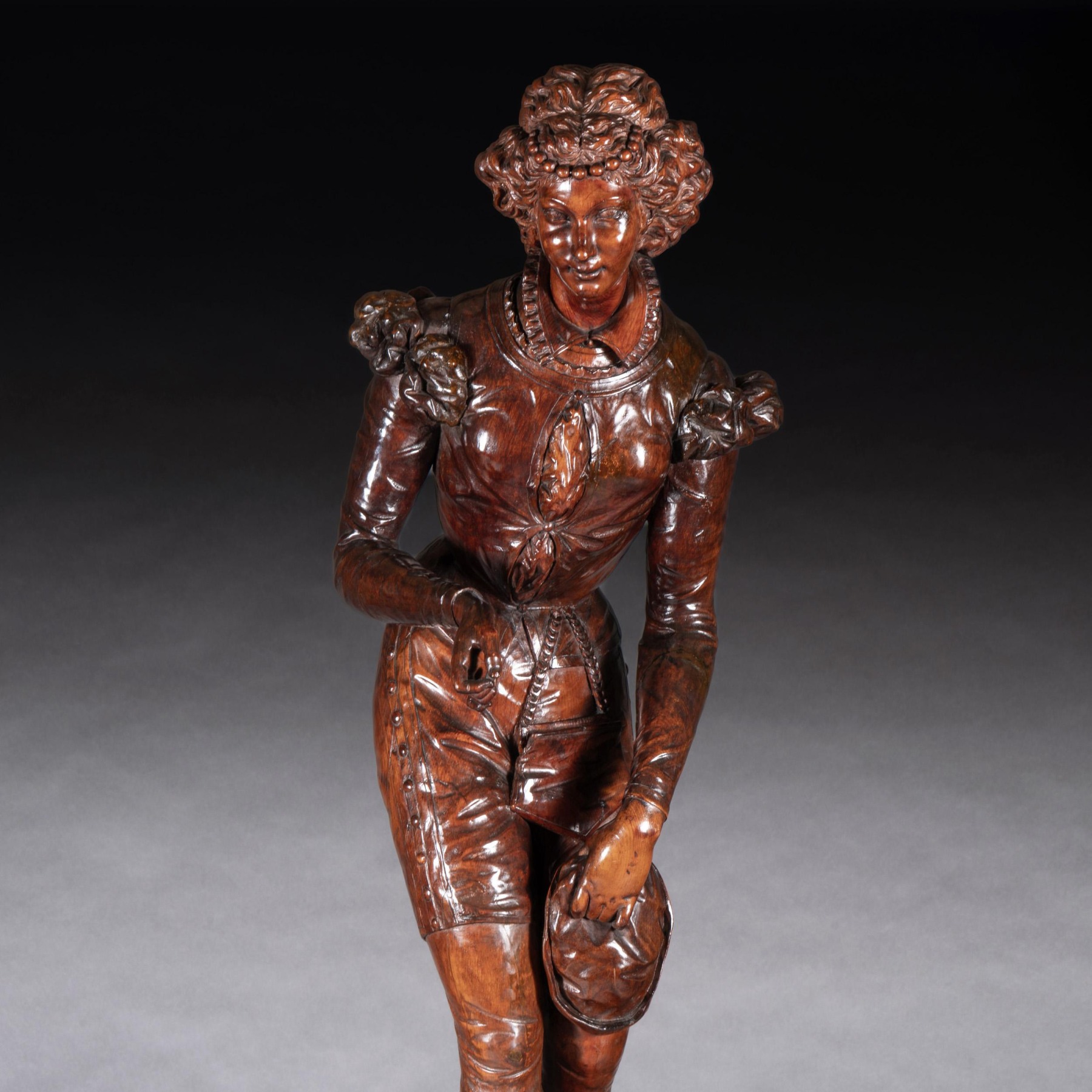
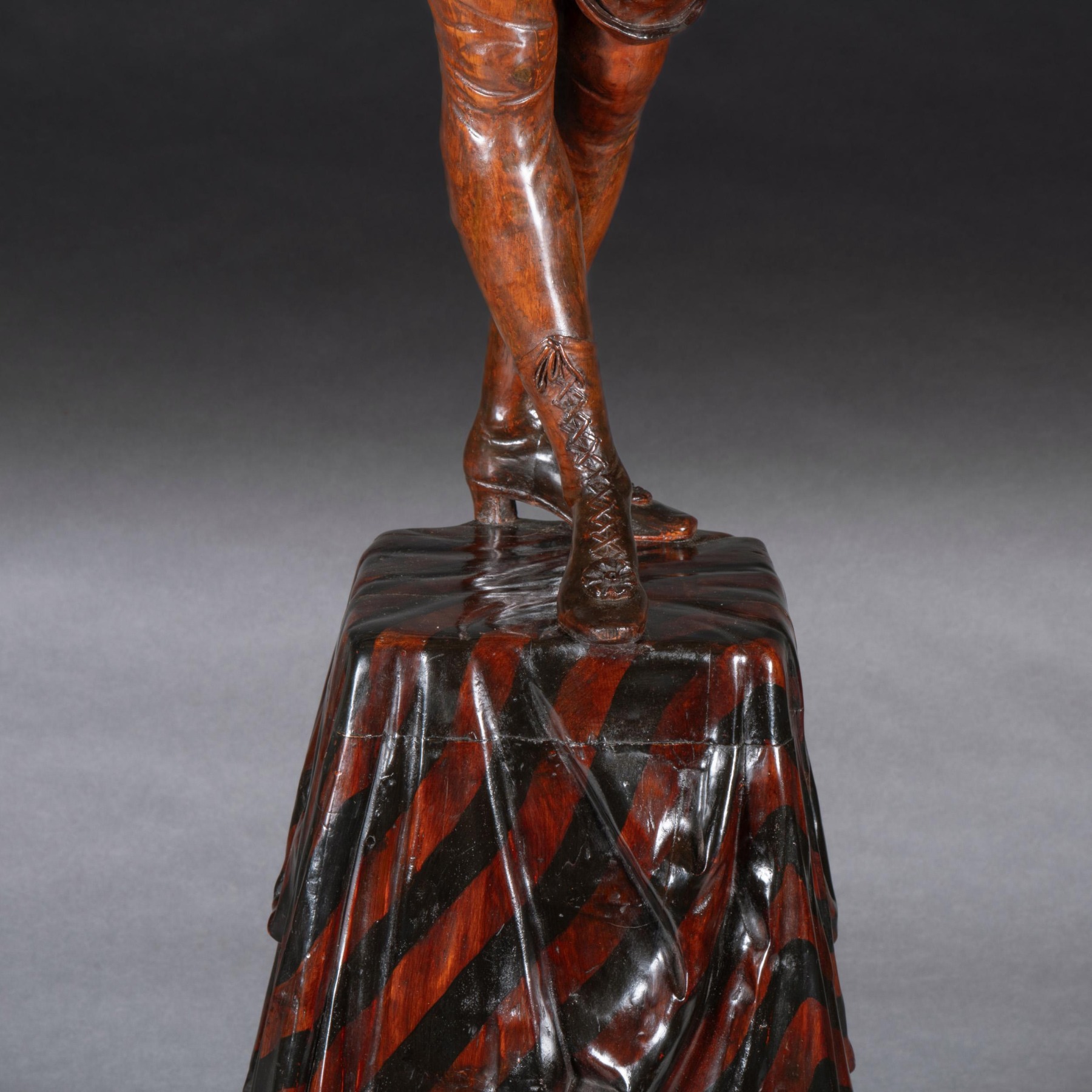
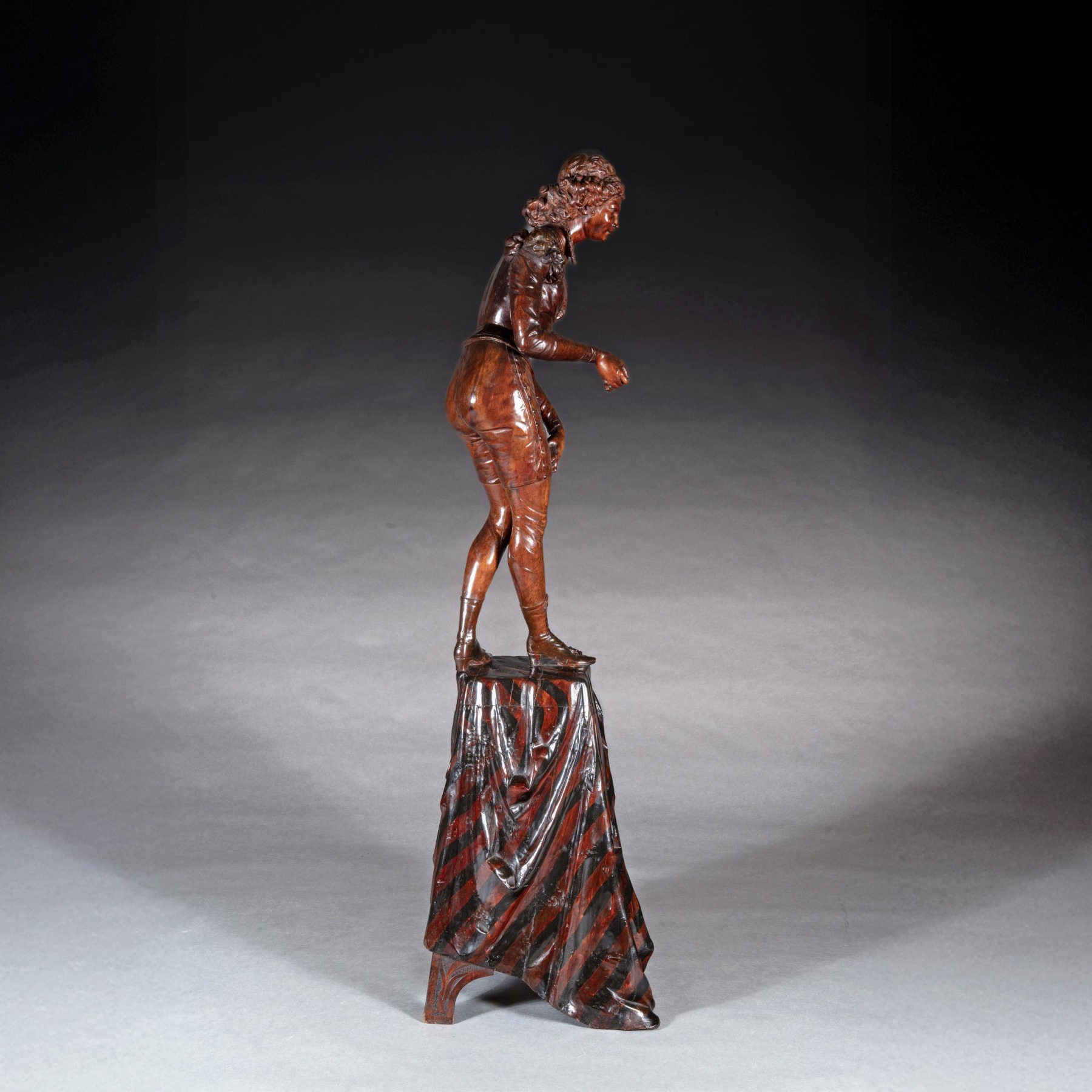
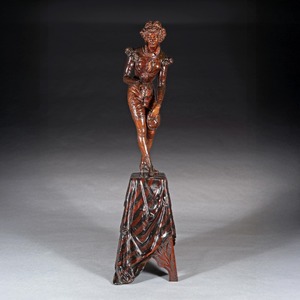
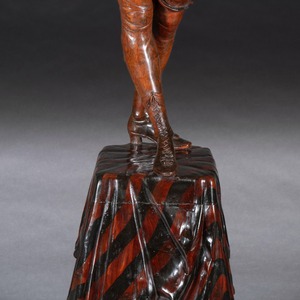
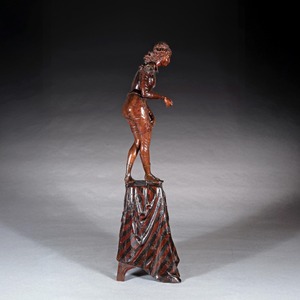
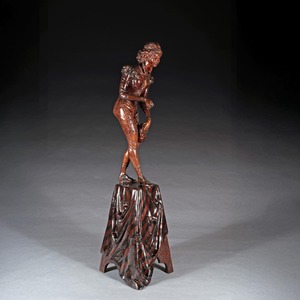
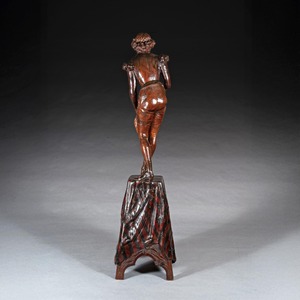
The female figure seems to wear more modern clothing than her male counterpart, her style of dress seemingly echoing some of the outfits worn by the likes of the great Parisian actress Sarah Bernhardt and her contemporaries. She wears high laced boots with platform heals and stands upon a carved pedestal which has been "covered" by a carved, draped textile, such as a silk throw, with an all-over striped pattern. The way the pattern flows across the numerous creases and folds created by the sculptor is endlessly interesting to the viewer. The lady's costume is cinched in at the waist with a belt from which a purse on a chain is suspended. She wears a pearl necklace and further pearls are perched on the front of her magnificent coiffure. The ruffled shoulders of her outfit are particularly finely sculpted and carved.
These figures may be seen as part of the fashion for page figures, often either acting as torcheres or holding platters and acting as dumb waiters, a style of interior decoration that seems to have originated in Italy, the Venetian Moorish figures being particularly famous. Also in this tradition are dummy boards, two dimensional painted boards in the form of figures which, according to some, were designed to scare off burglars but are now believed by most sources to have been a form of amusing household decoration. The present figures fall somewhat between these two traditions but their extraordinarily fine quality is due to their having been produced by a sculptor rather than simply a decorative carver.
It is likely that the two figures depicted here are intended to be theatrical characters but, regardless, they certainly add an air of theatricality to any interior, making it playful and intriguing at the same time.
Although unsigned, we are certain that these figures originate from the workshop of Valentino Panciera Besarel (1829-1902). A 2002 exhibition, "Valentino Panciera Besarel (1829‑1902): storia e arte di una bottega d’intaglio in Veneto” (Belluno), explored the artist's mastery of form and carving. Part of a dynasty of carvers and sculptors stretching back centuries. Besarel was famous enough to earn mentions in the English newspapers and magazines of the day. An article in Life, 27th of October 1881, reads as follows:
'Valentino Besarel is conspicuous for his beautifully carved furniture. He exhibited at the Milan Exhibition a frame bought by H. R. H. the Prince of Wales. Besarel is an artist whose talent has been transmitted to him from many a generation, for this family of sculptors dates from the middle of the 17th century'.
In his 1891 guide to Venice, Augustus John Cuthbert Hare recommended:
'Travellers should visit the Atelier (2795 Canal Grande) of Valentino Besarel. It is only in Italy that you find this interesting type of untaught artist of unerring taste, whose art is the sole object and interest of his life. Basarel (sic) is a native of Cadore, where his ancestors were carvers of wood in Titian's time'.
Despite Hare's comment about the artist being "untaught", Besarel did in fact have a formal training, attending the Academy of Fine Arts in Venice c.1855-57 having received his formative training in the family workshops. He was soon established as a fixture in the many international expositions of the late 19th century, exhibiting at Vienna in 1873 and Paris in 1878 where he was awarded the Médaille d’Or, a stunning triumph, and being awarded the distinction of becoming a Chevalier of the Légion d’Honneur. Besarel worked for both private and institutional clients, including work for churches and public sculpture. He was a highly regarded master at the time and it was often said that his talent and his figural style owed much to the influence of the 17th and 18th century Venetian master Andrea Brustolon. As such, it was a particular honour to be asked to complete a tribute to his inspiration, the Monumento ad Andrea Brustolon, 1878, which is visible in the Santa Caterina d'Alessandria in Dont, Val di Zoldo, Belluno. His works are held in many private and public collections, a particular collection being preserved in the Museo Francesco Borgogna (Borgogna Museum), Vercelli. When Besarel died in 1902, the Nuova Antologia, Vol. 186, recorded his death with great sadness, describing him as 'l’illustre scultore Veneziano'.
In more recent times, it is believed that the present figures formed part of the furnishings of one of the homes of the wealthy Boston businessman Harvey C. Wheeler (d.1947). Mr Wheeler made his fortune as the founder of the Initial Towel Supply Company in Boston and went on to live in a series of properties largely in the Boston and Lexington, MA, area. An amusing article in the Washington DC Evening Star, 3rd of December 1950, revealed that Mr Wheeler had also kept a house in Palos Verdes California. According to the article:
'The three and one-half acre ocean front estate in this Los Angeles suburb belonged to the late Harvey C. Wheeler. He made millions with a linen supply business in the United States, England and Australia. Mr Wheeler was 83 when he died three years ago. He lived in the house only about 15 days from the time he bought it in the 1930s, but he turned it into a lavish retreat.
In it were found hundreds of paintings of beautiful nude women, some hung on the walls of the 18-room mansion. But most were stacked in their frames like surplus furniture in a room built for a nursery.
More than 100 crates-all containing nudes-were shipped by Paris, London, Rome and other art centers. In addition the house was stocked with priceless antiques including such knick knacks as blue glass vases "from Czar Nicholas' winter palace".
All of the paintings and furnishings will be sold at auction. Catalogued are such items as a $40,000 handwoven rug which once cost $750 to be cleaned'
The female figure 743⁄4 in. (190 cm.) high
The male figure 751⁄2 in. (192 cm.) high
Height: 75 1/2 inches - 192cm
Depth: 24 1/2 inches - 62cm
Delivery of products is based on weight. Some products are not available for delivery, and will be collection only. For more information on delivery costs, please click here