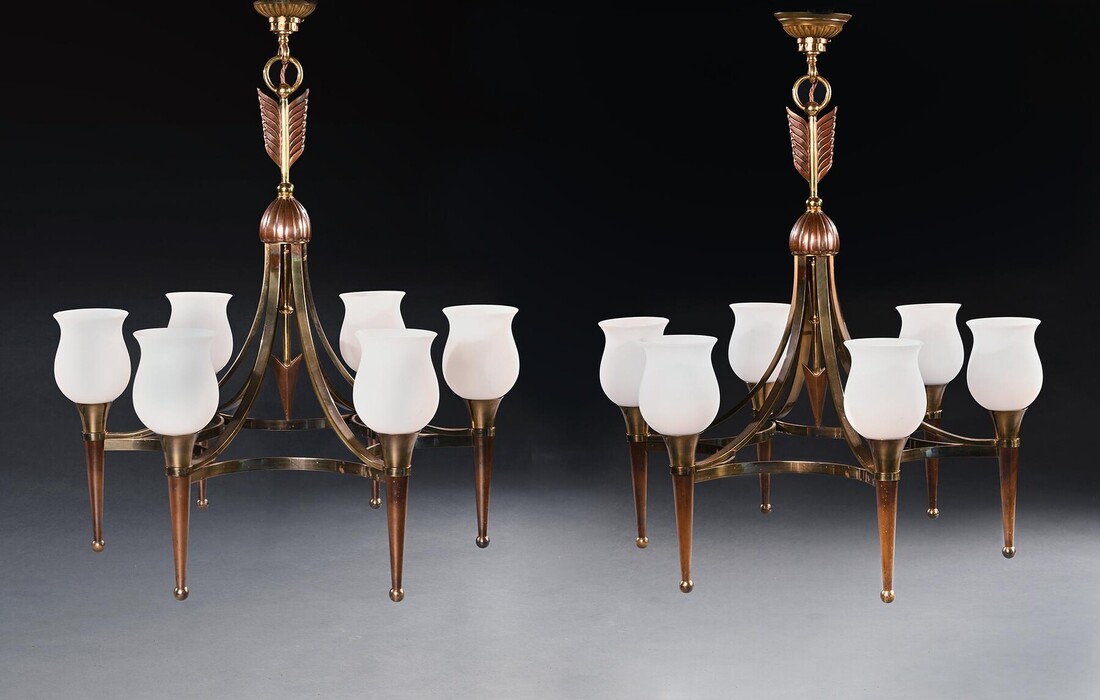
André Leon Arbus (1903-1969) and Gilbert Poillerat (1902-1988)
In this blog post we will examine the work and careers of two designers, Arbus and Poillerat, together as so many of their greatest works were produced in collaboration with each other. Both born in France within a year of each other, they would come to dominate specific fields of design at the time with their lighting designs particularly favoured today.
André Leon Arbus (1903-1969)
Born in Toulouse, Arbus made his name in Paris as a graduate of the École des Beaux-Arts, the legendary school which has trained many of the world's greatest architects and designers over the past three and a half centuries. Arbus was purely a designer and did not own a manufacturing division or workshop. As such, his talents involved creating the designs for his masterpieces and then selecting the right workshops to bring these designs to life. As such, he was famous for employing the talents of those involved in some of the enduring manufacturing institutions in France, a particularly good example being his use of the Aubusson workshops to create tapestries
and carpets and Veronese, a French lighting production house which it is believed crafted the majority of his lighting designs (of which more later).
Arbus's career reached new heights in 1925 when he won a medal at the International Exhibition of Modern Decorative and Industrial arts, this success quickly being followed by the prestigious Prix Blumenthal which was awarded to him in 1934. By this stage Arbus had become part of the leading circle of designers in France, leading to his selection for such important projects as a commission from the French Ministery of Agriculture in 1936. Arbus maintained a very close relationship with the various French governments for the rest of his life and worked on many interior projects to that end, also supplying pieces which were presented as diplomatic souvenirs to visiting heads of state. Perhaps one of his proudest moments, and largest projects, was his work on the complete redecoration of the French Embassy in Washington which took place in 1955.
Gilbert Poillerat (1902-1988)
Unlike his frequent collaborator Arbus, Gilbert Poillerat was a trained artisan as well as a designer. He trained at the École Boulle, a famous college for furniture makers, and specialised from an early age in metal engraving and chasing. He graduated from college in 1921 and soon began working for Edgar Brandt, believed by many to have been the most important and influential maker of wrought iron for decorative purposes of the period.
Poillerat worked for Brandt until 1927 and then moved to the firm of Baudet, Donon and Roussel. This company specialised in construction work but had a decorative ironwork division which Poillerat ran with aplomb. Poillerat's iron designs are said to be quite calligraphic in their nature, not so obviously influenced by the natural world as those of most of his competitors and predecessors. Poillerat exhibited at the salon d’Automne in 1928 and he frequently gilded his iron work, leading to him also experimenting with jewellery designs in the 1930s. At the same time he was working on patinated iron doors and a swimming pool for the first class area on the Normandie ocean liner.
Poillerat was a prolific maker and designer of all sorts of decorative items and furniture in metal; tables, grilles, doors etc. but lighting, both wall and floor mounted, became an increasingly important part of his business. He was able to create traditional and modernist designs, often seamlessly blending the two together to produce something that was quite his own.
In 1946, Poillerat became professor at the École National des Arts Decoratifs whilst still continuing to design for his commercial projects. He ended up teaching for 26 years, the culmination of a fruitful and effective career. His final major designs were produced in the 1950s and these were quite different from his earlier output, focusing on the new taste for the severe and functional.
Working Together
Arbus and Poillerat were frequent collaborators and one particularly famous joint design is a wall light, illustrated by Yvonne Brunhammer in her book André Arbus: Architecte-decorateur des Annees 40, p. 302. We are fortunate enough to have three pieces in our current stock which are all related to this design. Firstly we have a set of four wall lights
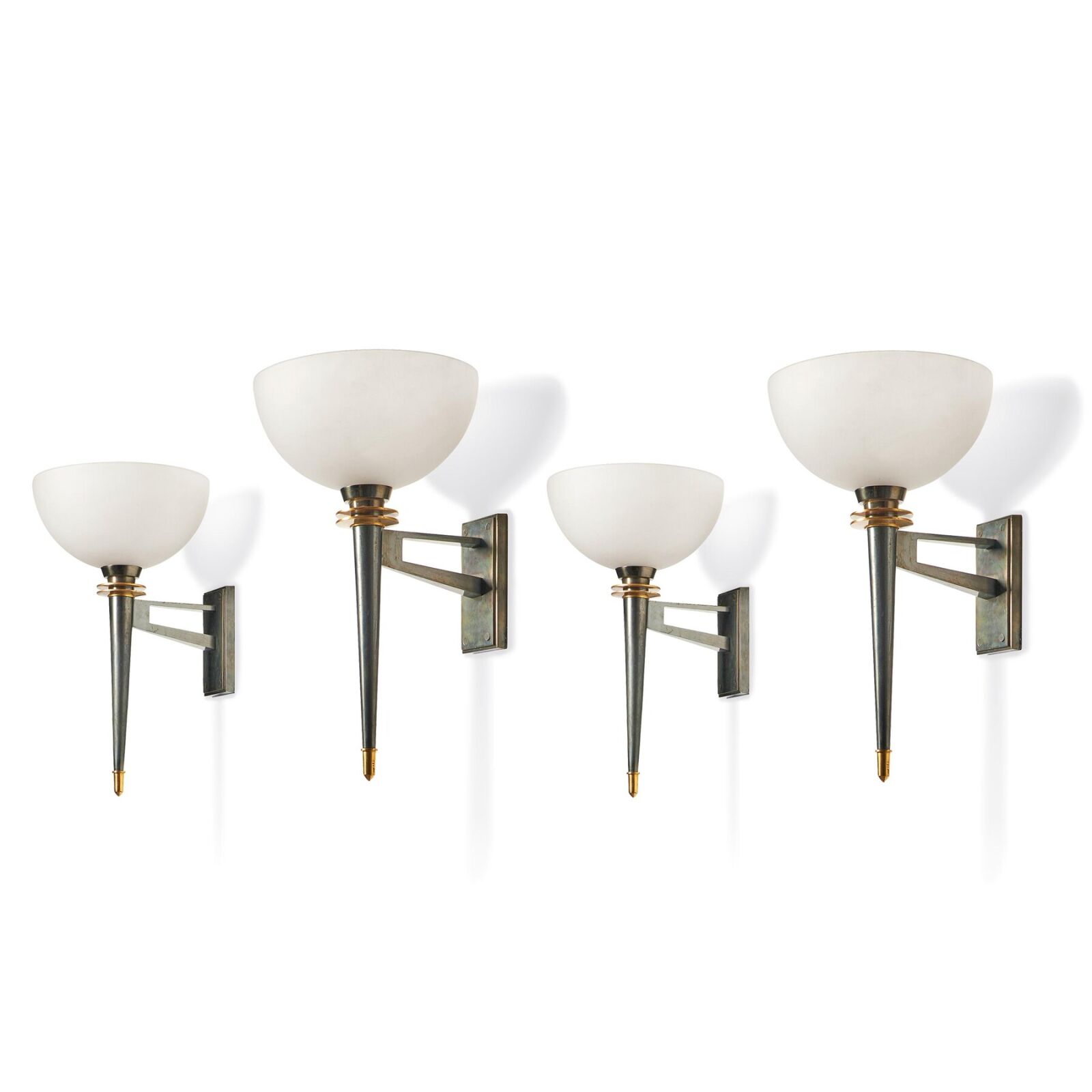
made directly after the model and extremely rare as a surviving set of four rather than the more common pairs and singles. The metalwork here is, as is expected from something produced in all likelihood in the Poillerat workshops, top quality with a fine gun metal patina and the lights all retain their original frosted glass basin shades.
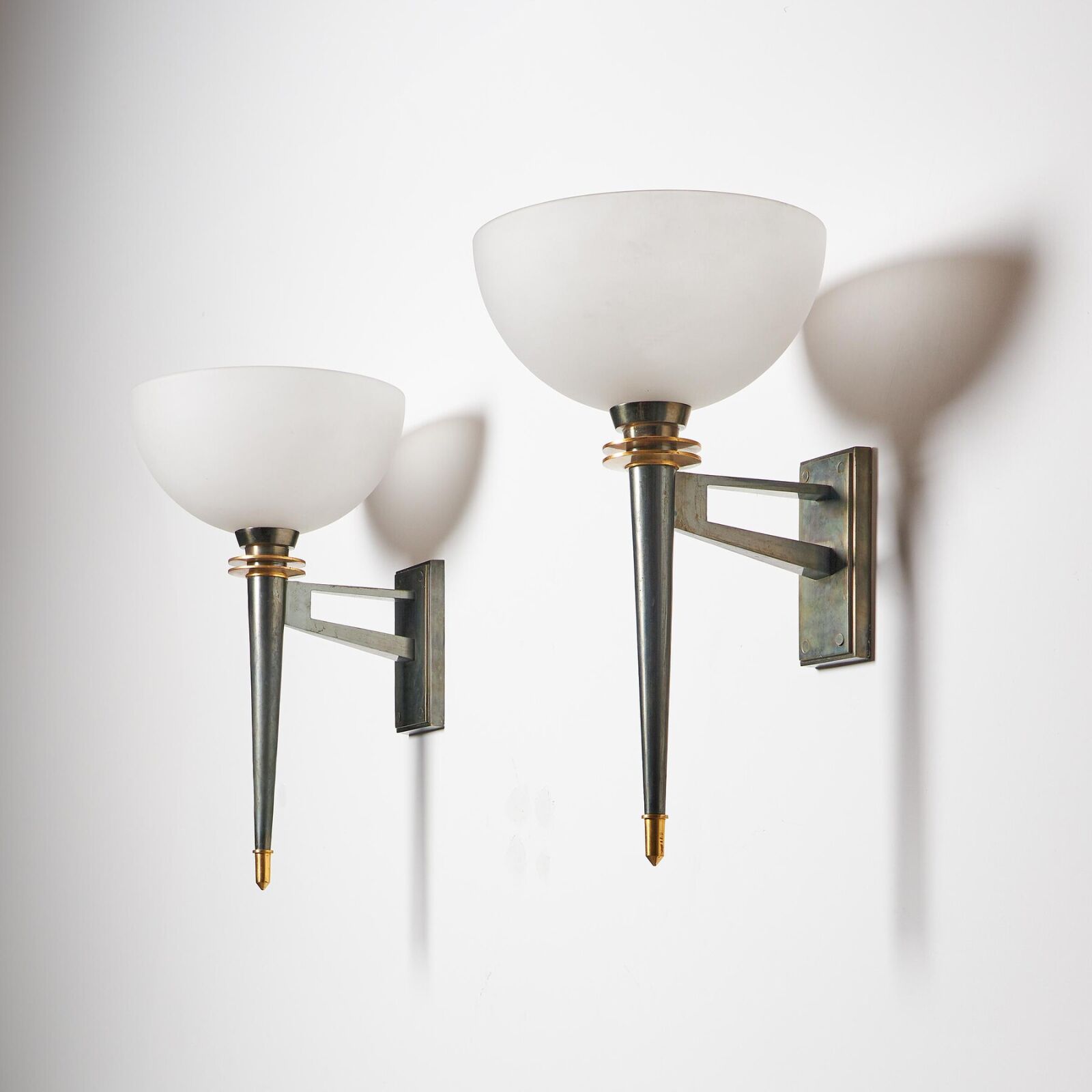
In addition, we have a fine pair of wall lights of the same model
In addition to the wall lights, we have an extremely unusual and interesting pair of 1950s chandeliers which clearly reference the Arbus and Poillerat model and seem likely to have been made by Maison Jansen in Paris
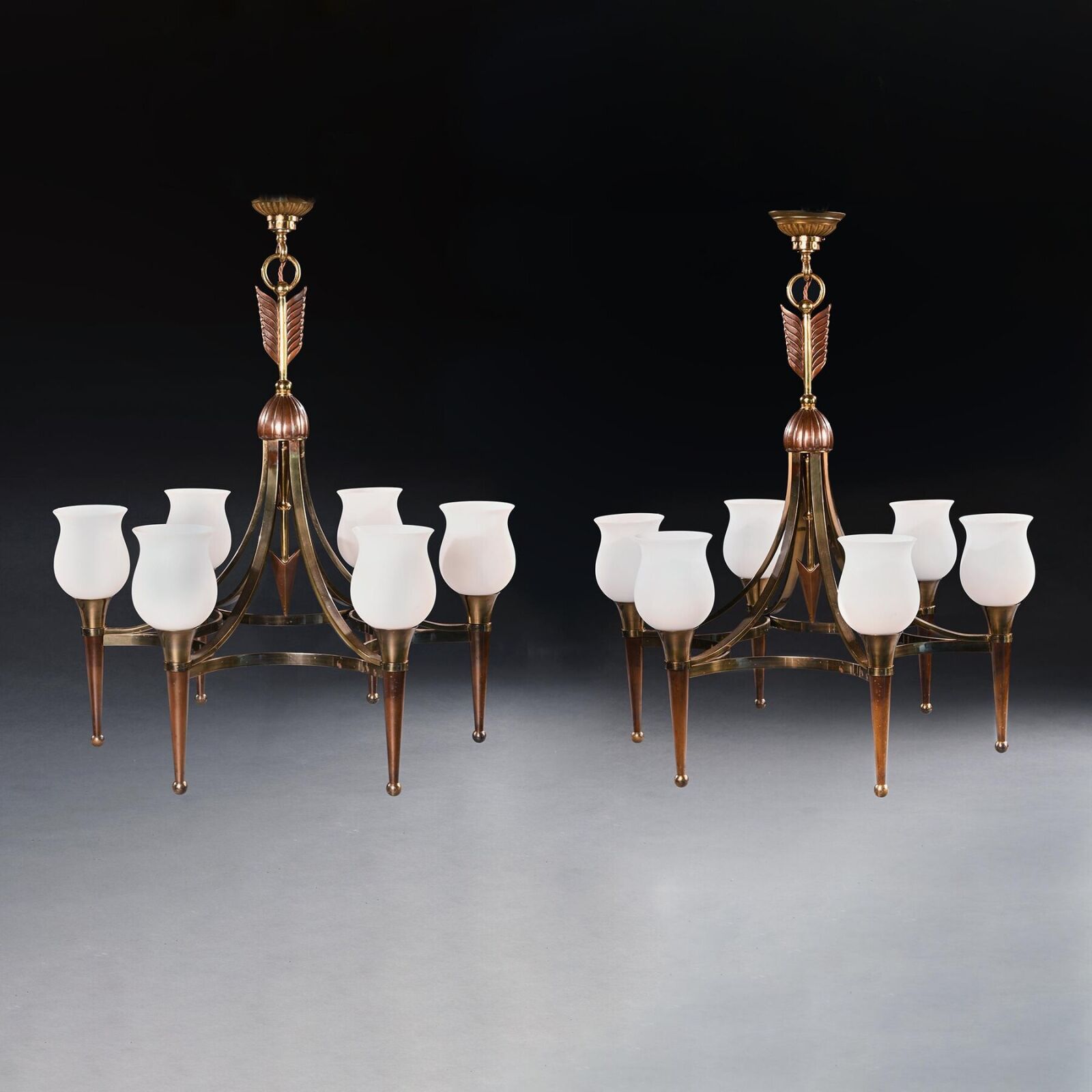
These remarkable pieces, with their arrow-form stems and torch-like lights are extremely neoclassical in form and highly sculptural. Pairs of chandeliers of this quality are very rare indeed and the metalwork here is once again of quite superior quality, the combination of both patinated and polished surfaces being especially noteworthy.
Please do let us know if we can supply any further details about these fine pieces or any other items of our stock. As the nights turn darker and winter draws in, now is the perfect time to consider updating your lighting. Please do look at our full range of lighting and mirrors here