Gillows of Lancaster and London-Enduring Quality Over Generations
One of the most famous names in antique furniture is that of Gillows. The precise date at which the Gillows family began to trade in their own right as cabinetmakers has not been established with complete accuracy but it was around 1730. The founder of the firm was Robert Gillow (c.1702-1772) completed an apprenticeship as a cabinetmaker in Lancaster, becoming free in 1727 or 1728, initially working in partnership with George Haresnape. Gillow was a catholic, as was Haresnape, and this was important as many of Gillows' customers throughout the 18th and 19th centuries came from prominent Catholic families who were extremely loyal with their patronage and a crucial factor in the firm's continuing success. Another part of the firm's success can be attributed to their concurrent role as merchant traders, allowing them to directly import the exotic timbers that they used from the West Indies and other locations, saving them a large amount of money in the process and allowing them to have greater control over the quality of the timbers used as well. By the 1740s, Robert was trading independently and making pieces for the local gentry and it was from this footing that the firm was to grow exponentially.
It was in the 1750s that the firm really began to take shape. It was a true family business with Robert's eldest son Richard assuming control for much of the firm's operations from the end of that decade. Richard's cousin James, based in London, sent designs up to Lancaster for the firm, allowing them to have a finger on the pulse of the fashionable London trade and react to the emerging styles and new tastes. James later became a journeyman cabinetmaker in London, based in St Martin's Lane near the Chippendale, Vile and Cobb and other prominent workshops of the time.
It is Richard Gillow who is credited with growing the firm and its clientele, making it one of the most important workshops of its kind and attracting an aristocratic clientele. Amongst the firm's customers were the likes of the Dukes of Hamilton and Lord Fauconberg, both invited to Richard's funeral in 1811.
Richard's brother, Robert, established a London Gillows workshop in partnership with William Taylor, a Gillows apprentice, in 1769 or 1770 and the firm prospered. James Gillow becoming a partner in the London firm at one point as well. Robert's sudden death in 1795, aged only 48, left the firm in financial difficulties, however, and it was at this point that the family's grip on the firm began to soften. Although documentation does not survive to prove a definitive date of transition, the family sold the firm to Redmayne, Whiteside and Co. at a date between 1805 and 1820, the new partners retaining the Gillow name and trading as Gillow and Co from Lancaster and London. The Gillow family retained stocks and shares in the firm and so continued to earn handsome annuities from the new partners for many years to come. The new partners were all former Gillows apprentices and so the DNA of the firm remained remarkably unchanged. Business was conducted much as before.
The customer base for Gillows remained the landed gentry until c.1800 when the firm was successfully able to court the nobility in both London and the provinces. The flexibility of the firm's dual workshops and their mercantile business set them in good stead and allowed them to both undercut other smaller makers on price and compete in terms of quality of goods and services, particularly in terms of the timbers used.
The Gillow archive of estimate sketchbooks and correspondence is remarkably complete and survives largely in Westminster Archives Centre in London. Very little relating to the Oxford Street, London, branch survives sadly but there are a number of drawings associated with this side of the firm which are part of the collections of the V&A. The firm was also highly unusual amongst English businesses in that much of the furniture they produced was stamped, not labelled, and thus pieces made by the firm, and identifiable as such, survive in larger quantities than would otherwise be the case. That having been said, large numbers of Gillows pieces survive which are not stamped and a lack of stamp should not be taken as definitive evidence that a piece was not made in their workshops.
The firm continued to supply exceptional furniture throughout the 19th century, eventually being absorbed in to Warings in 1903 creating Waring and Gillows which traded until 1953. The brand continued for some years after this, being used on a series of department stores and carpet stores with the name finally disappearing from the British high street in 1988 as Allied Carpets bought up the last remaining Gillows stores.
We always have a selection of Gillows pieces in our stock and currently have three very different pieces by the firm as well as a fourth which has a potential connection with the partners. All of these pieces come from different periods in the firm's history and offer the collector a chance to study the various styles which the firm produced across a variety of forms of furniture. As a result it makes sense to work through these items here chronologically from earliest made to latest.
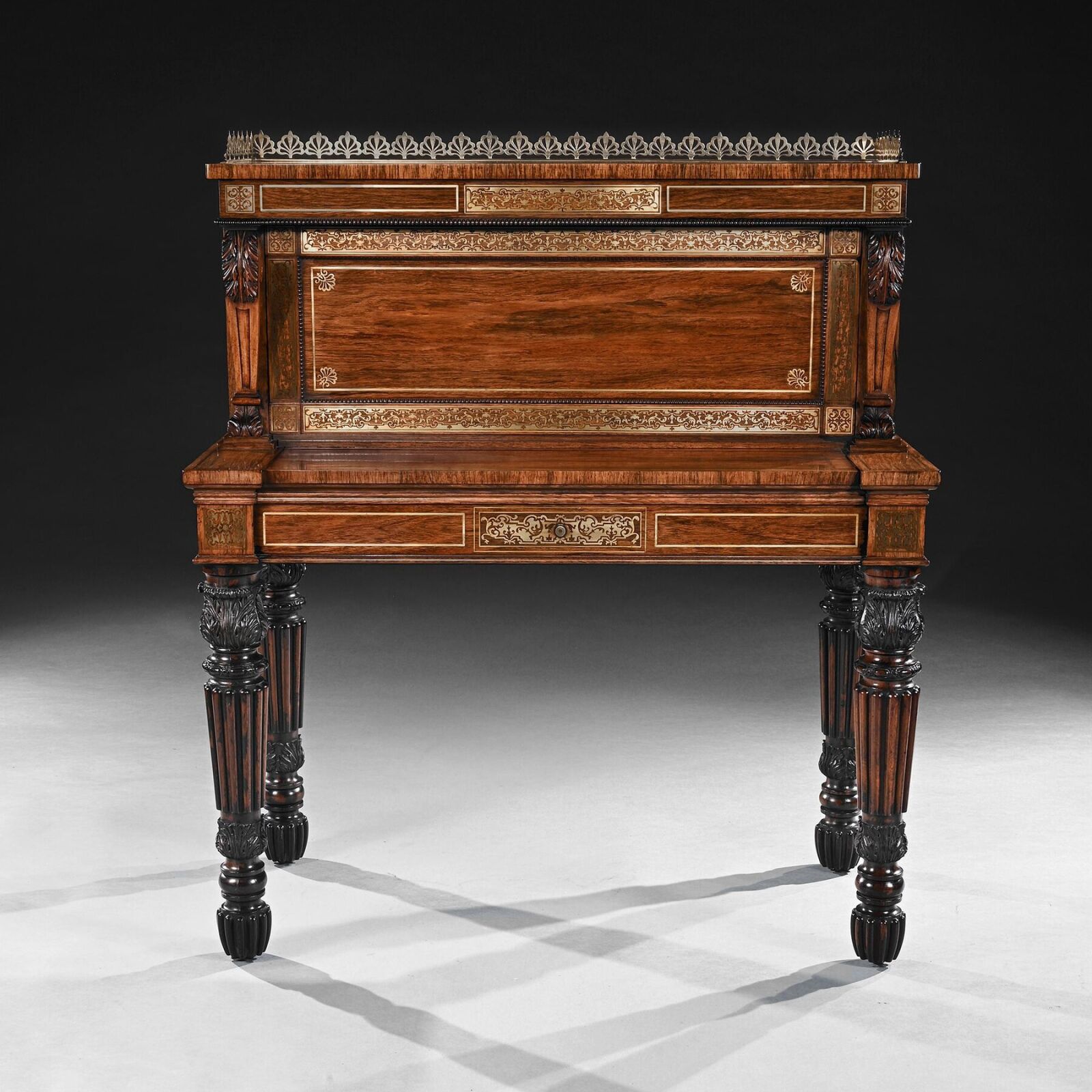
We begin, therefore, with a rather remarkable writing table/cabinet
Click Here To View This Writing Table
This piece was almost certainly made by the Oxford Street branch of Gillows c. 1820-1830. The reeded legs and reeded bun feet are “trademark” Gillows designs but the exceptional brass inlay, in the latest fashion, and the use of the finest rosewood with carved detailing and a gilt metal gallery all suggest a piece made at the forefront of London taste for a client of high means. Obviously a variant on the bonheur du jour, this highly interested table with a cabinet of drawers above is the all in one writing solution for any smart interior, as useful and beautiful today as it was when first made.
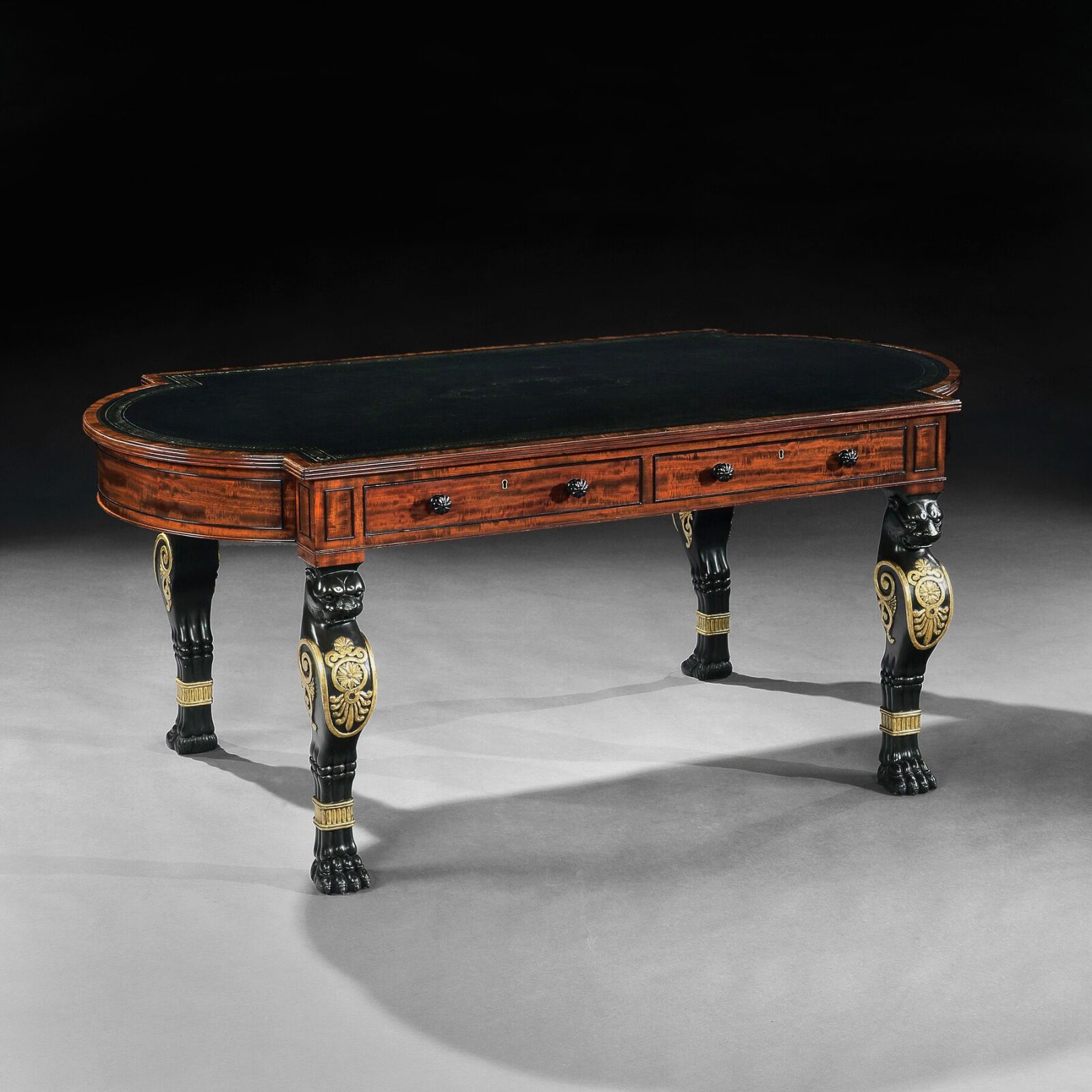
Also made c.1820 is this fine library writing table, stamped Charles Norman
Click Here to View This Writing Table
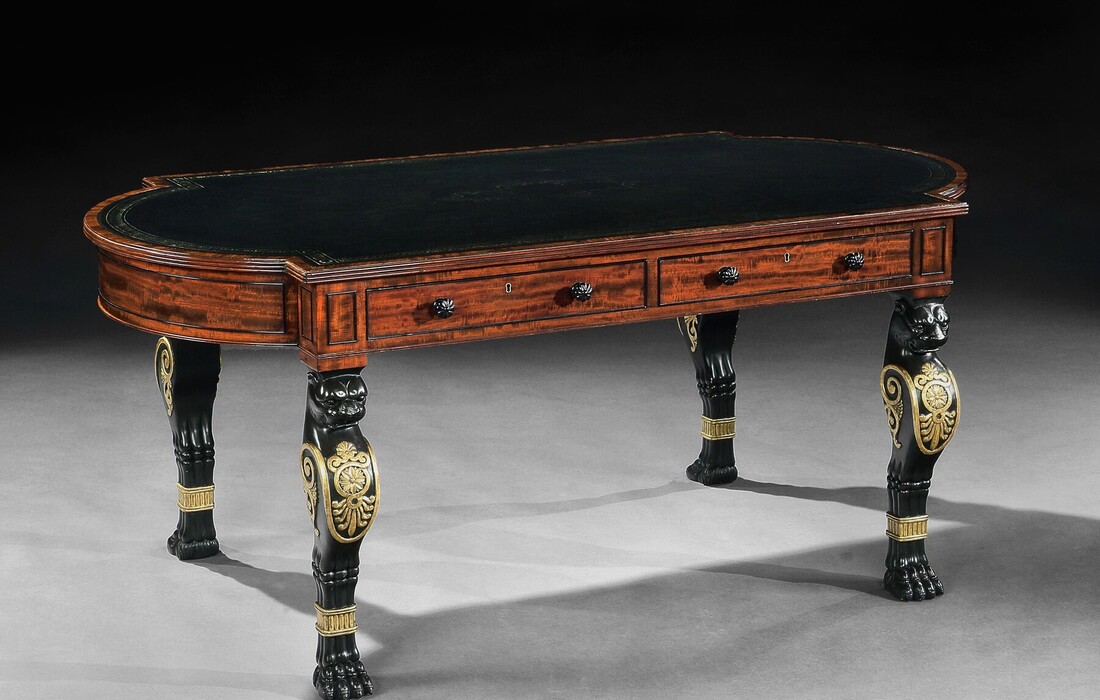
The Norman family of cabinetmakers were based in Yorkshire but a set of chairs following a Gillows pattern by Norman are recorded by Lucy Wood and, as such, it has been suggested that the firm may have had links to the Lancaster workshop either via an apprenticeship or another business arrangement. This is not documented, however, and so must remain speculative. What is not speculative is the quality of this piece. The table is made after a design by George Smith, one of the great designers of the regency period, and with its four lion monopediae, this is an imposing and beautiful table, It is certainly of Gillows quality and a lover of Gillows furniture is likely to be drawn to this wonderful table as well.
Our next item, also a writing table, is of the rare and sought-after kidney shape and was executed by the maker “JL” who has stamped it and dated it to the 30th of October 1865. This is likely to be a Gillows apprentice mark, the firm sometimes allowing its apprentices to mark their pieces in this way, making it easier to track the output of a particular workman when it came to paying their wages.
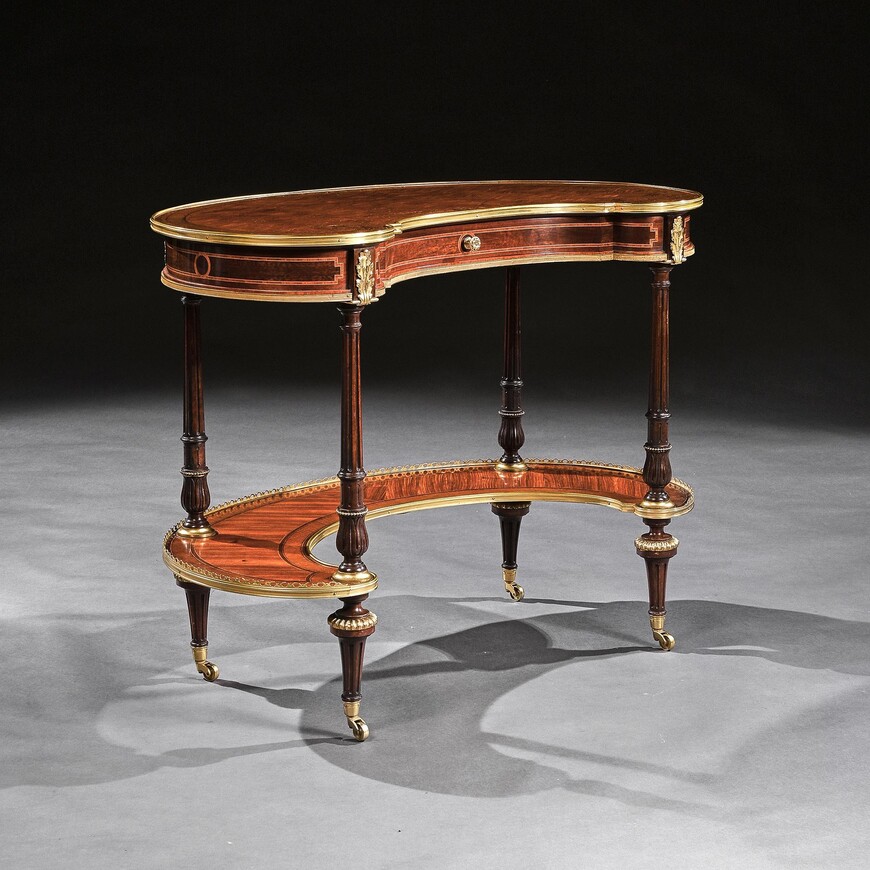
Kidney-shaped pieces are associated with Gillows-the firm produced a large number of desks in this shape which are eagerly contested whenever they appear for sale. Indeed there are many dealers in purely 18th century furniture who will bend their rules and purchase these pieces when they become available, such is the quality and decorative appeal. The fine dealers Apter-Fredericks had many of them during their time trading for example.
Our table is profusely mounted with ormolu in the French Louis XVI manner and has the highly useful feature of a shaped undertier or platform stretcher, giving more storage or display space if required. This is a lovely example of the quality of Gillows' output during this period.
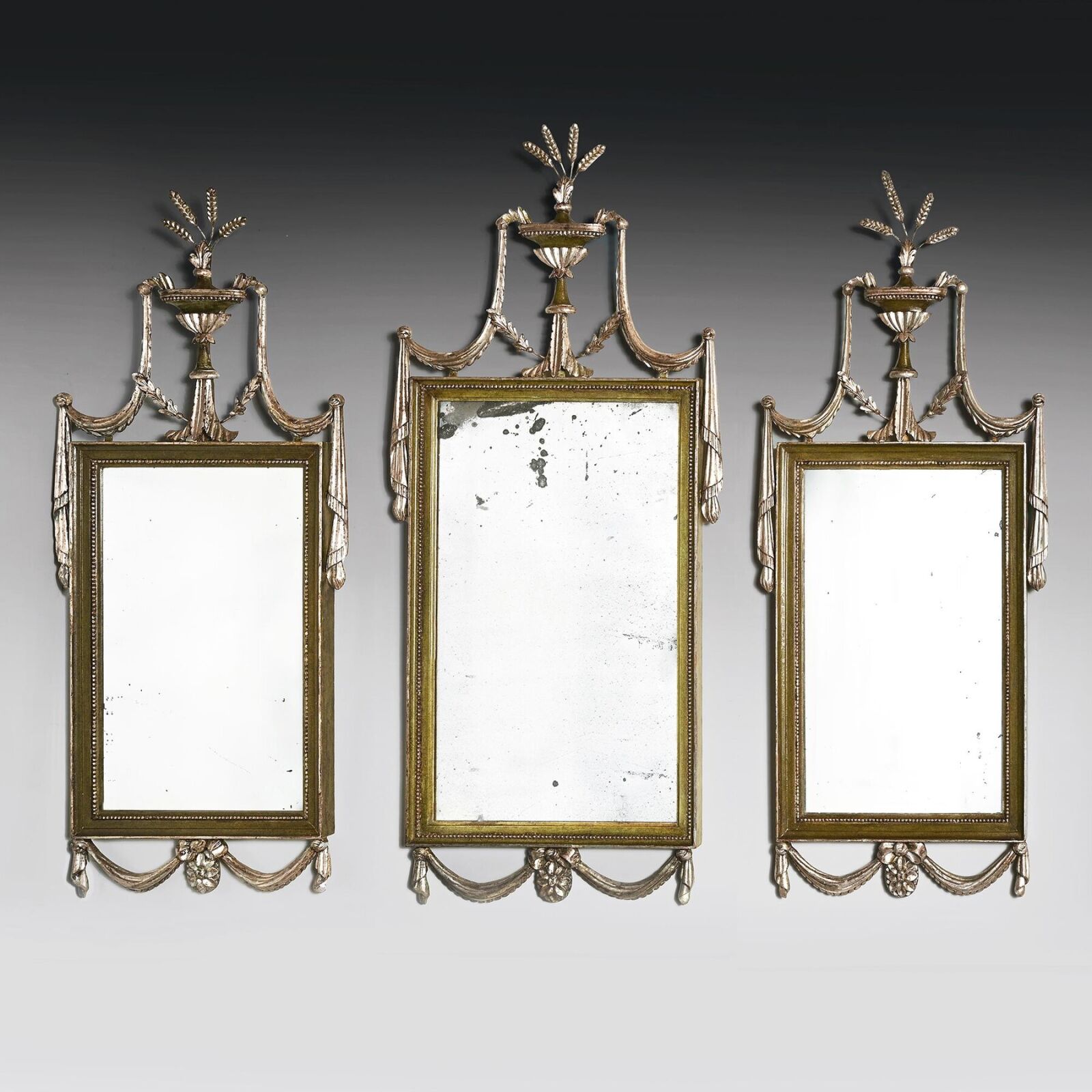
We also have a suite of three mirrors in stock, one larger example and then a pair of smaller mirrors of the same design, which are products of the Gillows workshops towards the end of the 19th century
Click Here To View These Mirrors
The mirrors were made for Coilsfield House, later renamed Montgomerie House, and built on the site of Coilsfield Castle for the Earls of Eglinton in Scotland. The Earls of Eglinton were long-time Gillows clients and these mirrors, with their highly unusual silver and green painted colour scheme, were produced in a pattern first used by the firm as early as the end of 18th century. Designs relating to the mirrors are illustrated in Dr. Lindsay Boynton's Gillow Furniture Designs 1760-1800, one of two landmark books on the firm along with Dr. Susan Stuart's two volume monograph which is essential reading. The Earls of Eglinton first ordered from Gillows around 1794 and seem to have remained loyal customers for the next century or so, some of the surviving pieces from their properties retaining their Gillows labels or being stamped. The present mirrors are not marked in any way but the combination of the provenance and their similarity to known Gillows designs leaves no doubt as to their authorship. The wheat sheaf crestings on these pieces, seen on several Gillows pieces, may also have had special meaning for the Earls of Eglinton as part of their coat of arms includes garbs (what sheafs) as part of the quarterings.
Hopefully this post will inspire our readers to research the Gillows firm and their output further and if we can help you in any way then please don't hesitate to contact us. We are passionate about all of the pieces that we sell and we are always happy to answer any questions that you may have.
Wishing all our friends and clients old and new all the very best for the festive season and for the new year ahead.