Dame Lucie Rie (1902-1995)
We always like to have a good stock of objects to complement our furniture and have a longstanding interest in British studio pottery, something which works well with both our mid century pieces and our 18th and 19th century furniture. Studio pottery has recently become a very significant collecting area and there are four names which stand apart from the others in terms of their desirability to collectors. Three of those names are those of men-Bernard Leach, Hans Coper and the Japanese master Shoji Hamada. The other name on this list, and the only women in this select group, is that of Dame Lucie Rie.
Born in Vienna on the 16th of March 1902, Lucie Rie, nee Gomperz, studied potting with Michael Powolny at the Kunstgewerbeschule, a specialist crafts and art school associated with the Wiener Werkstätte association in the city which attracted the greatest talents in many fields and gave them a common forum to publicise their works. Rie's early life was marked by tragedy, her brother Paul being killed fighting in WWI in 1917. She through her energies in to studying the art and architecture of past civilisations, inspired particularly by her maternal uncles collection of ancient Roman pottery which had been excavated at various sites around Vienna. The forms of these early pots inspired the artist and she set up her first studio in 1925, also exhibiting at the International Exhibition in Paris that same year. Although she did not win a prize on this occasion, she was awarded the silver medal at the 1937 exhibition, also held in Paris.
Rie emigrated to England in 1938, fleeing the Nazi regime and leaving her estranged husband, businessman Hans Rie, in Austria. The couple decided to separate but Rie continued to use his name for the rest of her life despite their official divorce taking place in 1940. The war years were extremely difficult for Rie who lived in London with Erwin Schrödinger, the famous physicist, to whom she offered lodgings. Both were Austrian émigrés and bonded on the basis of that shared experience. Rie made it through the lean wartime period largely by producing handcrafted ceramic buttons which were bought by leading couture fashion houses of the day. This required Rie to learn how to precisely mimic the colours and sometimes textures of various fabrics in her pottery, firing the buttons to the precise colour required. It has been suggested that this highly skilled work was crucial in informing Rie's virtuosic abilities as an artistic potter moving forward. It was also during the course of this work, in 1946 shortly after the end of the war, that Rie met and hired Hans Coper to help with her work. Coper had no previous experience with ceramics at all but was keen to learn about sculpture. He was taught the basics of wheel throwing by Rie's friend Heber Matthews and soon proved to be something of a natural. Rie and Coper held their first exhibition together in 1948 and Coper became a partner in the Rie studio, staying there until 1958. Their friendship was lifelong, ending only with Coper's death in 1981.
Rie had met and enjoyed the work of Bernard Leach and the circle of potters that grew up around him in Cornwall. Where Leach took most of his inspiration from oriental forms, inspired by his friend Shoji Hamada, and produced pieces that were usually restrained in form and with a limited colour palette, Rie liked to work in a far greater range of coloured glazes and the forms of her pieces were usually modernist in their inspiration.
Amongst the many collectors of Rie's work is Sir David Attenborough, the legendary naturalist interviewing Rie for the BBC in her studio in 1982. A replica of that same studio can now be seen in the V&As ceramic galleries, a further tribute to this pioneering potter.
Today Rie is probably the most sought-after of all of the great studio potters of the mid 20 th century and we are delighted to be able to offer two pieces made by the potter to our friends and clients. The first piece is a tall stoneware vase
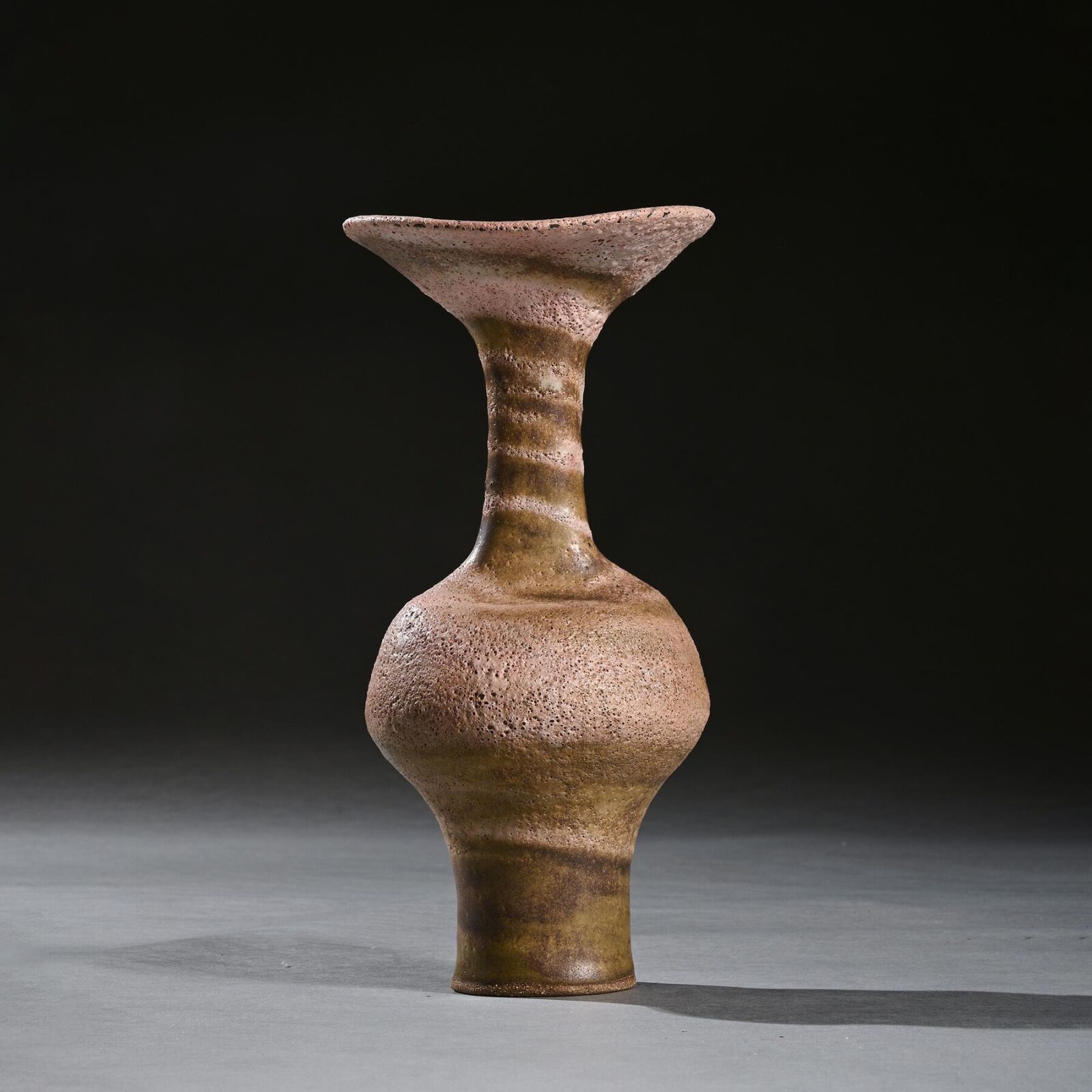
With its flaring lip and its mixed stoneware body, this piece is the archetypal Rie piece. A vase of identical form was selected by the Royal Mail for illustration on its series of stamps celebrating and commemorating the studio pottery movement in Britain. When offered at Phillips afterwards the vase soared to a final price of £165,000. Vases of this form are illustrated by John Houston and David Cripps in their monograph Lucie Rie, published by the Crafts Council, in 1981 (pages 51 and 58) and by Tony Birks in Lucie Rie, published 2009, p.189.
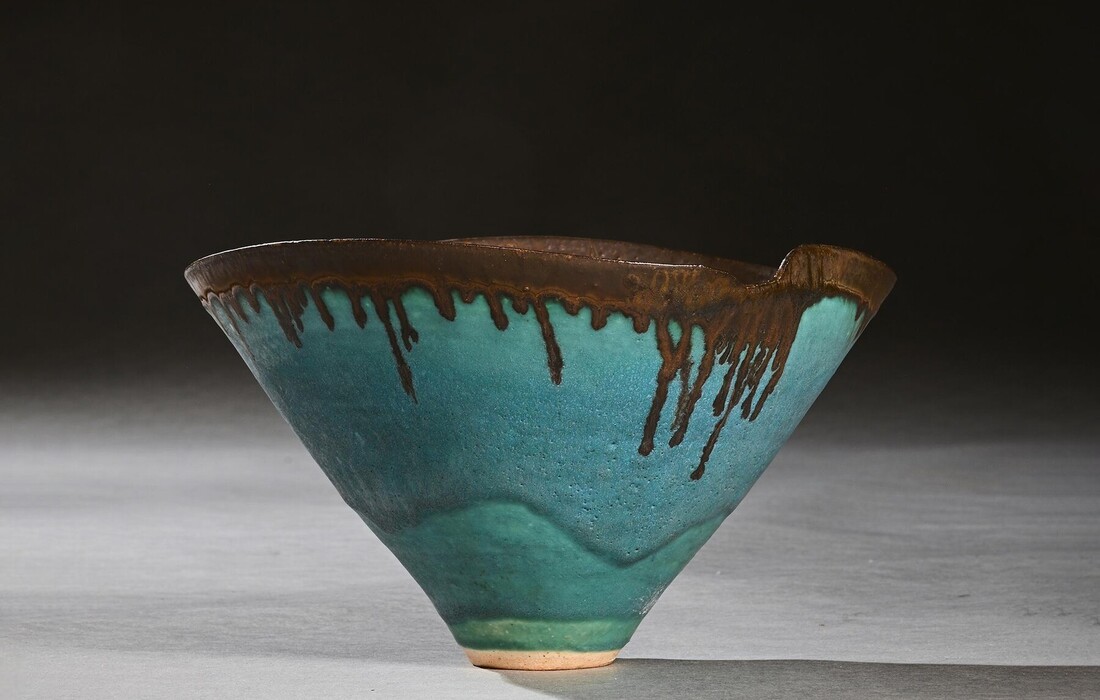
The other Rie piece we currently have in stock is a charming bowl with a wavy rim and interesting dripping manganese glaze.
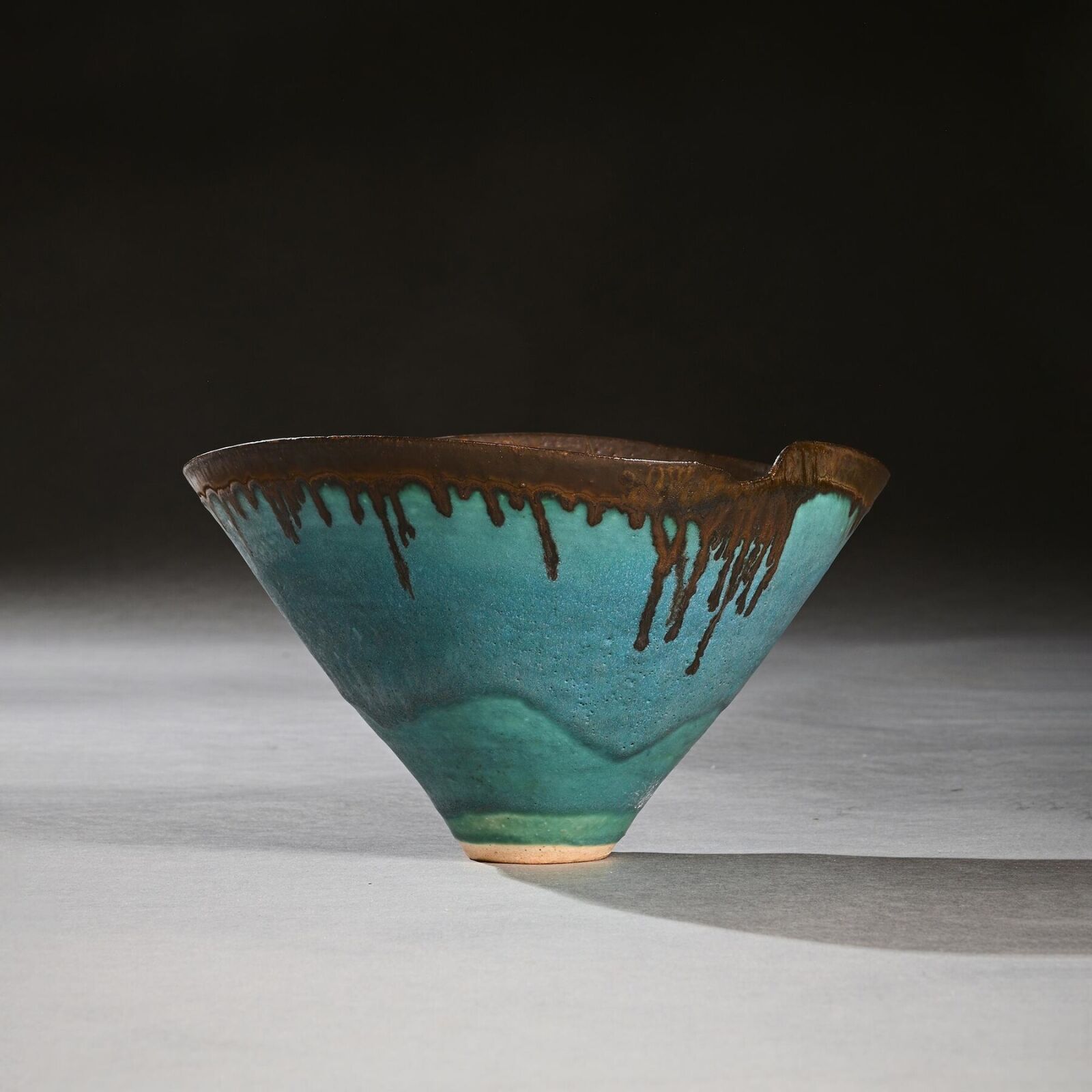
This piece was in the collection of Cyril Frankel, a film director who was central to much of the BBCs arts coverage in the 1950s and 60s and responsible for the documentary on Rie in 1982 in which the artist was interviewed by Sir David Attenborough. Frankel bought his pieces, of which there were many, directly from Rie. This piece was then acquired from Frankel by the previous owner so its entire history is known. Frankel was a discerning collector and pieces with that provenance are all the more desirable as a result.
The market for Rie's work is booming, the current auction record for her work being £320,000 with several other pieces having made in excess of £100,000. These pieces are continuing to appreciate in value and are true works of art that will enhance any interior. Please don't hesitate to contact us if we can help further and supply additional details relating to either of these fine pieces of ceramic sculpture.