Makers and Masters - Jacques Adnet
This post is the first in a series which will attempt to explore the works of particular makers or designers who feature in our current collection and are normally makers whose work we have also handled regularly in the past. The posts will explain why we are drawn to their designs and what particular qualities set their work apart from their contemporaries and hopefully help to inspire our clients, and potential clients, to explore these pieces in greater depth on their own.
The first name we have chosen to explore is that of Jacques Adnet. Born in 1900 in Châtillon-Coligny, France, Adnet worked initially at the Studio La Maîtrise, the in-house design section of the Galeries Lafayette department store in Paris alongside his twin brother Jean. Jacques continued to work there until age 28 when he branched out on his own as director of La Compagnie des Arts Français , a position he continued to hold until 1960. The Adnet brothers had met the highly influential designer Maurice Dufrene whilst still at Lafayette and this connection had inspired Jacques to pursue interior design. At La Compagnie, Adnet supervised a team of highly skilled decorators and he himself was president of the Salon des Artistes Decorateurs for two years from 1947.
Adnet was an early adopter of modernism, keenly aware of the fact that industrial materials could be used to create interior items such as furniture and lighting and equally keen to create a synergy between building and contents in this way. He first exhibited his designs aged 25 at the Exposition Internationale des Arts Décoratifs et Industriels Modernes, the landmark exhibition that gave the world the term Art Deco. Although he had plenty of experience with the traditional furniture in France and beyond and had designed furniture of his own from a young age, the mature Adnet style really only emerged in the 1950s as Jacques began experimenting with designing a new and distinct range of furnishings of his own. At this time he was engaged in a series of very high profile decorating projects including most famously the private apartments at the Elysée Palace, home of the French president, and UNESCO's meeting room, also in Paris. Adnet decided to create a series of pieces worthy of such prestigious commissions and his pieces, modernist to their very core, were an instant success. So successful were these designs, Adnet was made president of the École nationale supérieure des arts décoratifs in 1970. He died in 1984, having left a lasting mark on the fields of interior and furniture design.
As with all great designers, when looking for a piece by Adnet the buyer would be advised to look at first for designs which capture the essence of the man and his style. It is these pieces, trademark pieces if you like, which are most desirable as they are instantly recognisable and contain the essence of what made Adnet such a legendary aesthete. In Adnet's case, his lighting designs are his most recognisable pieces, fusing as they do practical utility with modernist lines and top quality materials. Adnet was particularly famed for his use of leather in his designs and much of the leather used on his pieces came directly from Hermès, the world famous saddler turned luxury brand. Leather from this source was understandably highly expensive and it is this attention to detail and quality at any cost which was a cornerstone of Adnet's production.
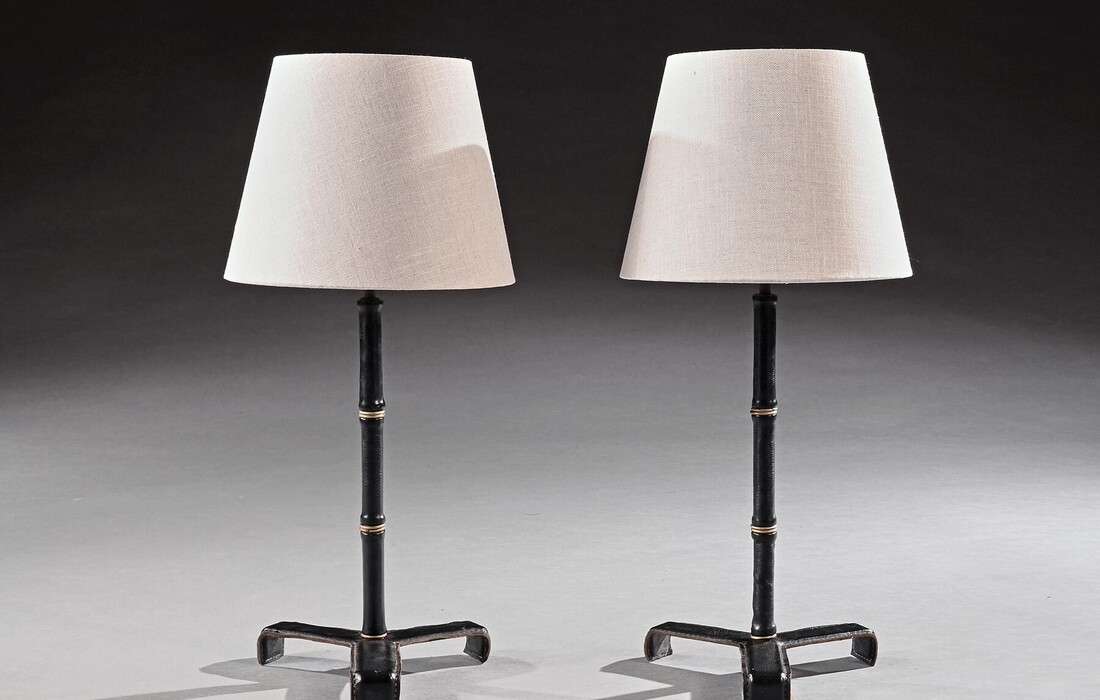
In our current collection we have three table lamps attributed to Adnet, one pair and one single, all designed around 1955 and all incorporating hand stitched leather covers over a metal frame.
Beginning with the pair:
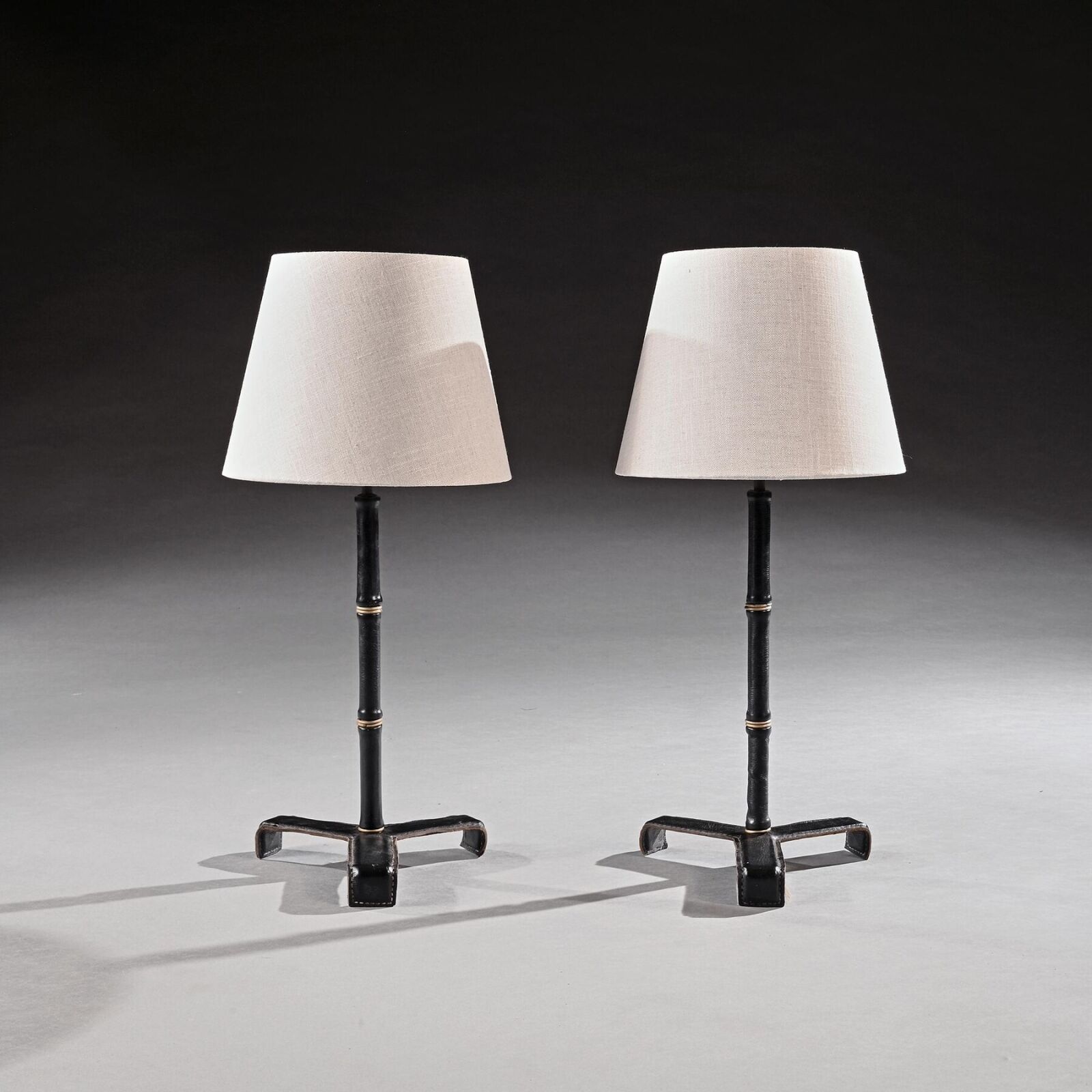
It is immediately obvious that these fine pieces have a real presence and a quirkiness which is missing from much modernist design which can be quite cold and clinical. The pieces make use of chinoiserie decoration-the stitched leather covers on the stem are intended to simulate bamboo with the growth rings obvious on the stems. The overall pared-back aesthetic is pure modernism however and the fusion of these two seemingly disparate styles so effectively is part of Adnet's genius. The lamps survive in remarkably good condition, showing that they have been treasured since new, and they will add a layer of decorative detail to any interior whilst still remaining remarkably practical objects at their core.
Our single Adnet lamp is perhaps even more impressive and interesting:
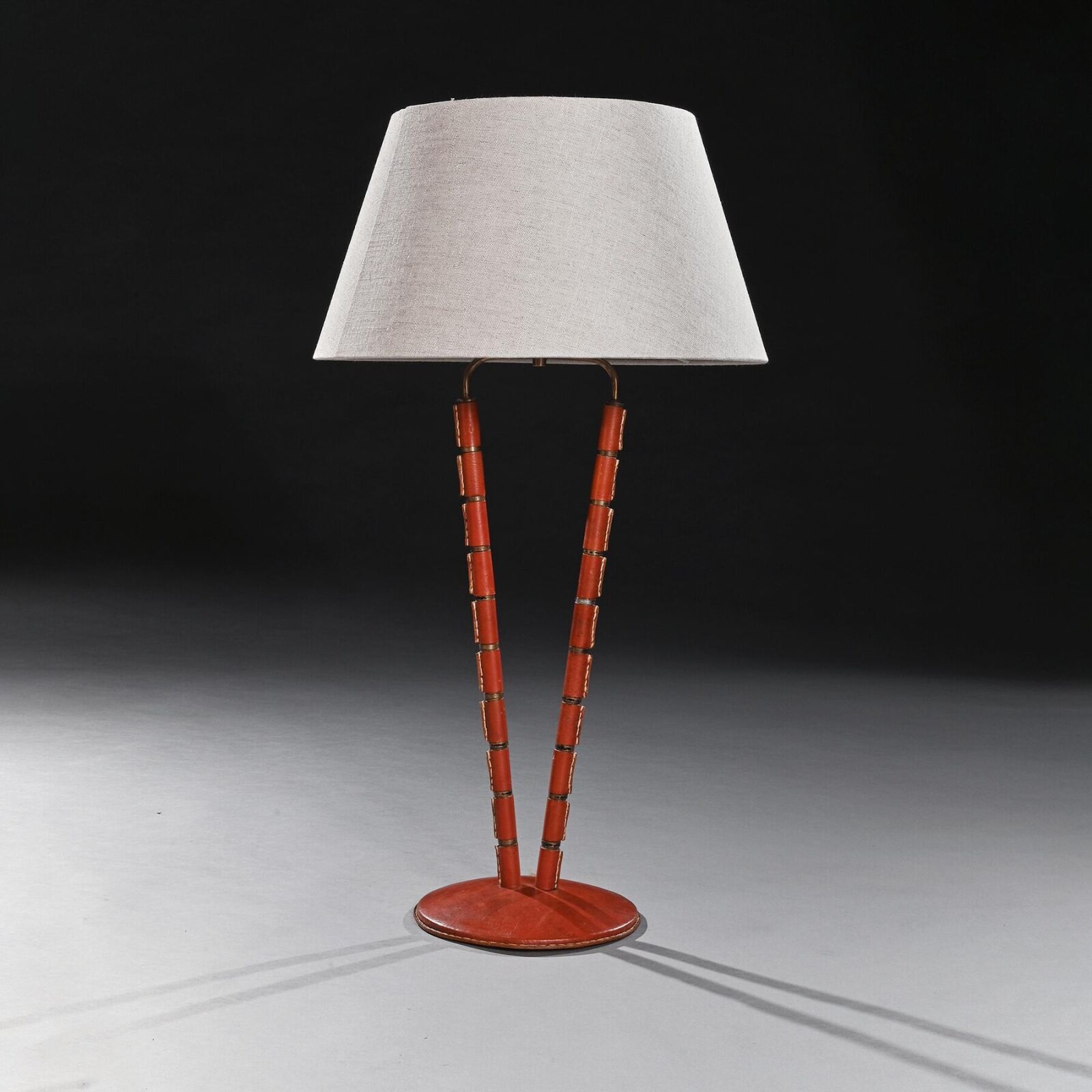
The materials used are largely the same-brass in this case covered in red leather and, again, the chinoiserie style makes an appearance in the form of two bamboo canes which converge at the base and support the shade at the other end. The single stemmed version of this design is perhaps Adnet's most famous lighting design and this twin stemmed version is much rarer and has not been as widely reproduced in the 21st century, making it all the more unusual and interesting. The quality of the Adnet workshop's materials and finishing is highly evident here and, again, this piece survives in excellent original condition. This lamp presents an opportunity to acquire a notable piece of 20 th century design and perhaps begin a collection of pieces from this fine designer and his workshop.
We hope that this little introduction to the work of Adnet and his firm has been of interest and if we can supply any further information relating to our lamps then please do not hesitate to contact us.
We would be delighted to hear from you.